
Dangle Earrings: The Ultimate OEM Sourcing Guide for Global Buyers
Dangle Earrings: The Ultimate OEM Sourcing Guide for Global Buyers
How US, EU, UK, and MENA importers, DTC store owners, and procurement teams are winning with dangle earrings — sourced direct from vetted Chinese workshops.
The Cross-Border Fashion Jewelry Reality
The global fashion jewelry market is not a single market. It is a patchwork of regional consumer preferences, import regulations, platform compliance requirements, and buyer expectations that shift faster than most sourcing cycles can accommodate. For DTC store owners running Shopify storefronts in Texas or Berlin, and for importers consolidating container loads for MENA distribution, the product category at the center of demand has remained remarkably consistent: dangle earrings.
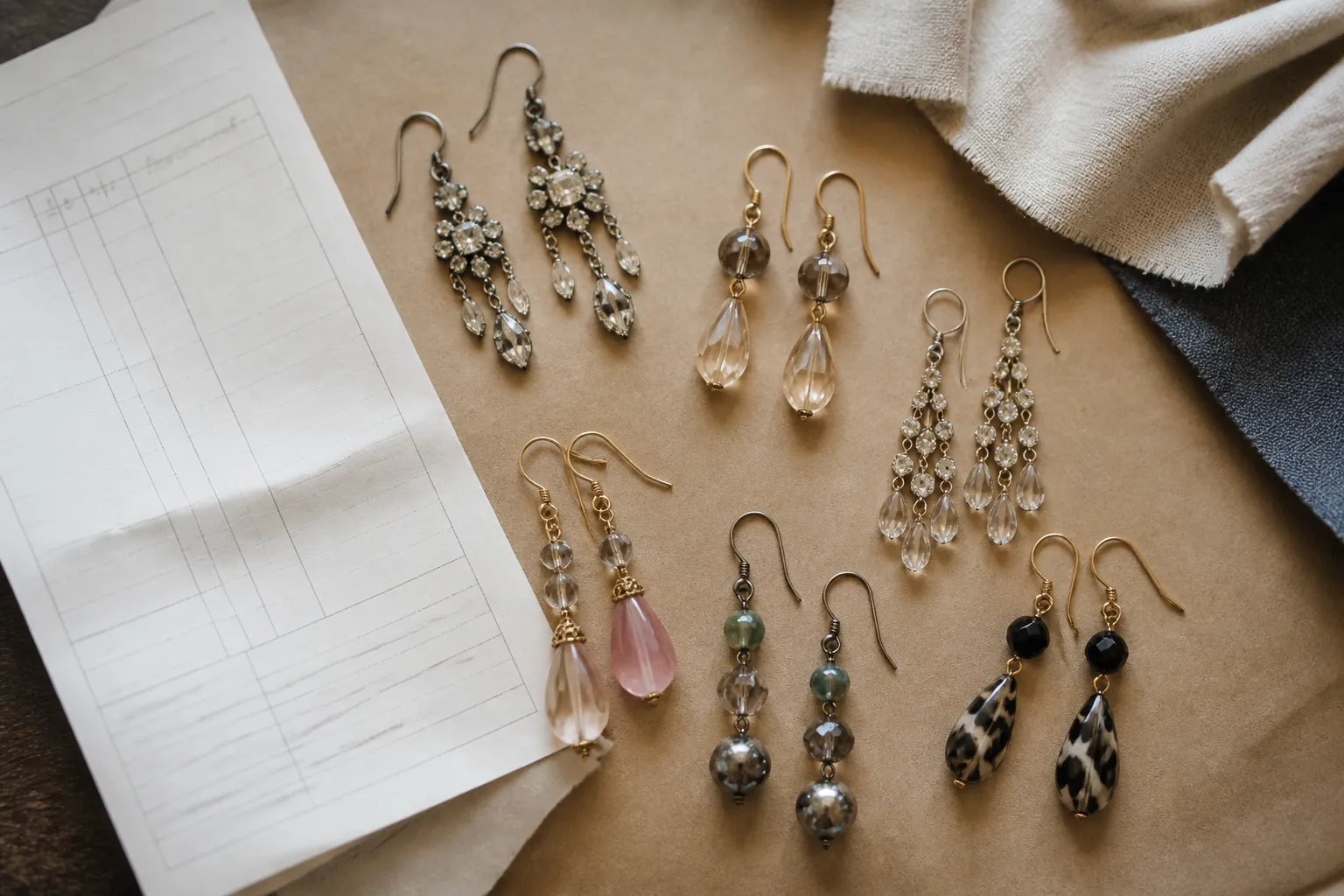
Dangle earrings — also called drop earrings — are among the highest-velocity SKUs in fashion jewelry globally. Their visual impact in product photography translates directly to click-through rates on Meta and TikTok ads. Their perceived value far exceeds their cost of goods when sourced correctly. And their style range, from vintage crystal drops to gradient glass bead cascades to layered rhinestone designs, is wide enough to serve everything from a boutique bridal accessories brand to a fast-fashion accessories importer running seasonal drops. The challenge is not demand. The challenge is supply chain execution across borders.
Cross-border jewelry sourcing sits at the intersection of three pressures that generic procurement platforms and wholesale catalogs consistently underestimate: regulatory compliance by destination market, the need for genuine OEM customization at commercially viable MOQs, and the communication burden of coordinating with Chinese workshops through multilingual procurement teams. A buyer in Riyadh, a brand owner in Amsterdam, and a DTC operator in Miami may all want the same gold-plated crystal dangle earring — but they need it packaged differently, certified differently, and invoiced differently. Understanding how these pressures interact is the starting point for any sourcing strategy that actually scales.
Why Generic Solutions Fall Short for Cross-Border Fashion Jewelry
Most wholesale jewelry directories and B2B marketplaces are optimized for volume, not for the specific execution requirements of cross-border DTC and OEM buyers. They surface minimum order quantities without disclosing factory tier, they show catalog photography that bears little resemblance to production samples, and they leave language gaps that create expensive mistakes — wrong alloy grade, wrong hook style, wrong plating thickness — that are only discovered after goods clear customs.
For dangle earrings specifically, the failure modes are predictable. A crystal drop earring that photographs beautifully in a supplier's studio sample may use glass beads that fail the EU's REACH nickel-content restrictions. A rhinestone dangle listed as "gold plated" may use a flash-plating process that delaminates within 30 days of retail sale, generating returns that destroy a DTC brand's review profile overnight. And for OEM buyers who want to private-label a gradient bead dangle under their own brand, most platforms cannot accommodate low-MOQ custom packaging, branded tags, or color-matched hardware without routing through a trading company that adds margin and removes accountability.
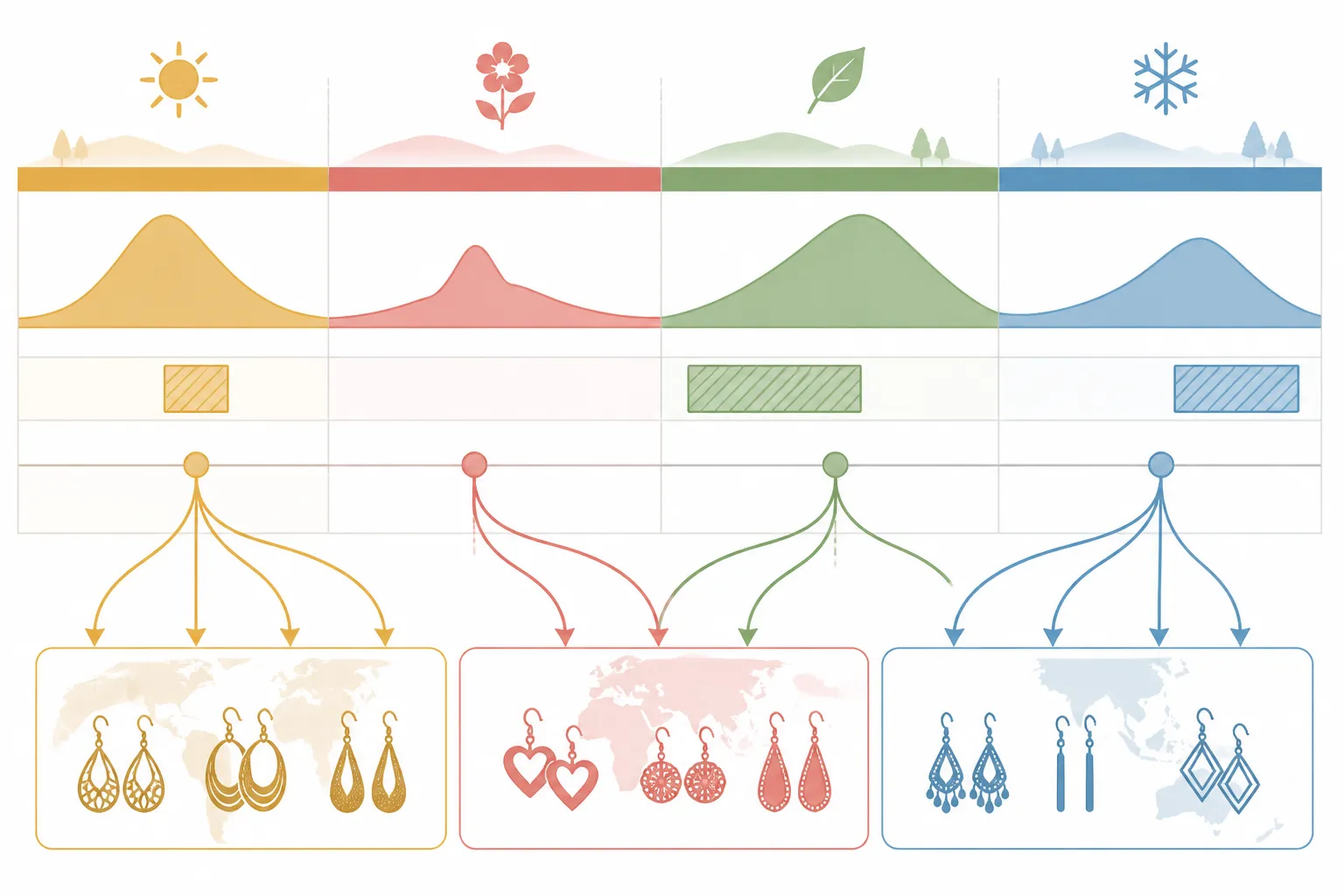
The vertical also has compounding seasonality that generic sourcing tools ignore. Dangle earrings spike in Q4 (holiday gifting), around Valentine's Day, and in spring/summer collections tied to wedding and festival season. Missing a production window by two weeks on a Chinese New Year holiday schedule means missing a peak sales window entirely. Cross-border buyers need suppliers who communicate proactively about factory capacity calendars, not reactively after a delay has already happened.
Core Use Cases
1. DTC Brand Owners Building a Signature Earring Line
The specific problem: A DTC jewelry brand launching or expanding its earring category needs a range of dangle earring styles that look cohesive in a lookbook, photograph well for paid social, and can be reordered in response to sell-through data — without committing to 1,000-unit minimums per SKU.
How sourcing vetted dangle earrings addresses it: Working with a supplier who offers low MOQ on OEM styles allows a DTC brand to test four to six dangle earring designs in the same drop — vintage crystal, glass bead gradient, two-tone, rhinestone — without tying up cash in overstock. The supplier's in-house QC inspection before shipment means the brand receives production-consistent goods rather than samples that diverge from bulk.
What success looks like: A brand achieves 40–60% sell-through on initial SKUs within the first four weeks of a collection launch, generating the data needed to place a reorder confidently. Return rates from quality defects stay below 2%.
Example scenario: A UK-based DTC accessories brand tests six dangle earring colorways from a Hangzhou workshop, receives QC-cleared samples within [lead time] days, and converts three winning styles into a full autumn drop — all under their own branded card backing.
2. Importers Building Seasonal Inventory for Multi-Retailer Distribution
The specific problem: An importer supplying independent jewelry boutiques and regional chains across the US or EU needs to consolidate a seasonal dangle earring assortment that covers multiple price points, ships on a defined schedule, and arrives with documentation that satisfies retailer compliance requirements (country-of-origin labeling, nickel-free certification for EU accounts).
How sourcing vetted dangle earrings addresses it: A vertically integrated supplier who can provide both product and documentation — material certificates, country-of-origin declarations, and compliance test reports — removes the importer's need to commission third-party lab testing on every new style. Transparent trade terms (FOB, CIF, or EXW with clear Incoterms communication) allow accurate landed-cost modeling before a purchase order is placed.
What success looks like: The importer delivers a seasonal assortment to retail accounts on time, with zero compliance rejections at the retailer level, and maintains a gross margin consistent with pre-season projections.
Example scenario: A Florida-based accessories importer consolidates a spring dangle earring assortment — three styles, four colorways each — from a single Hangzhou supplier, receives a complete documentation package, and ships to 40 boutique accounts without a single compliance query.
3. MENA Buyers Sourcing Statement Earrings for Regional Consumer Preferences
The specific problem: Buyers sourcing for the Gulf Cooperation Council (GCC) market or broader MENA distribution need dangle earring styles that align with regional aesthetics — often larger, more elaborate statement designs with gold-tone hardware — and require suppliers who can communicate effectively in Arabic, navigate GCC import documentation requirements, and process payments through trade finance instruments common to the region.
How sourcing from a multilingual supplier addresses it: A supplier offering native Arabic-language service eliminates the communication gap that causes specification errors and delays. Statement dangle earring styles — rhinestone cascades, layered crystal drops — map well to GCC consumer preferences. Transparent trade terms and familiarity with Letter of Credit (LC) and Telegraphic Transfer (TT) payment structures reduce friction for MENA procurement teams.
What success looks like: A MENA distributor receives a container of fashion dangle earrings that clears GCC customs without amendment, is paid for under terms their finance team can execute, and lands in retail within the planned seasonal window.
Example scenario: A Dubai-based jewelry distributor places an OEM order for branded statement dangle earrings, communicates the full specification in Arabic with the supplier's team, and receives a pre-shipment QC report before releasing payment.
4. OEM Buyers Developing Private-Label Earring Collections
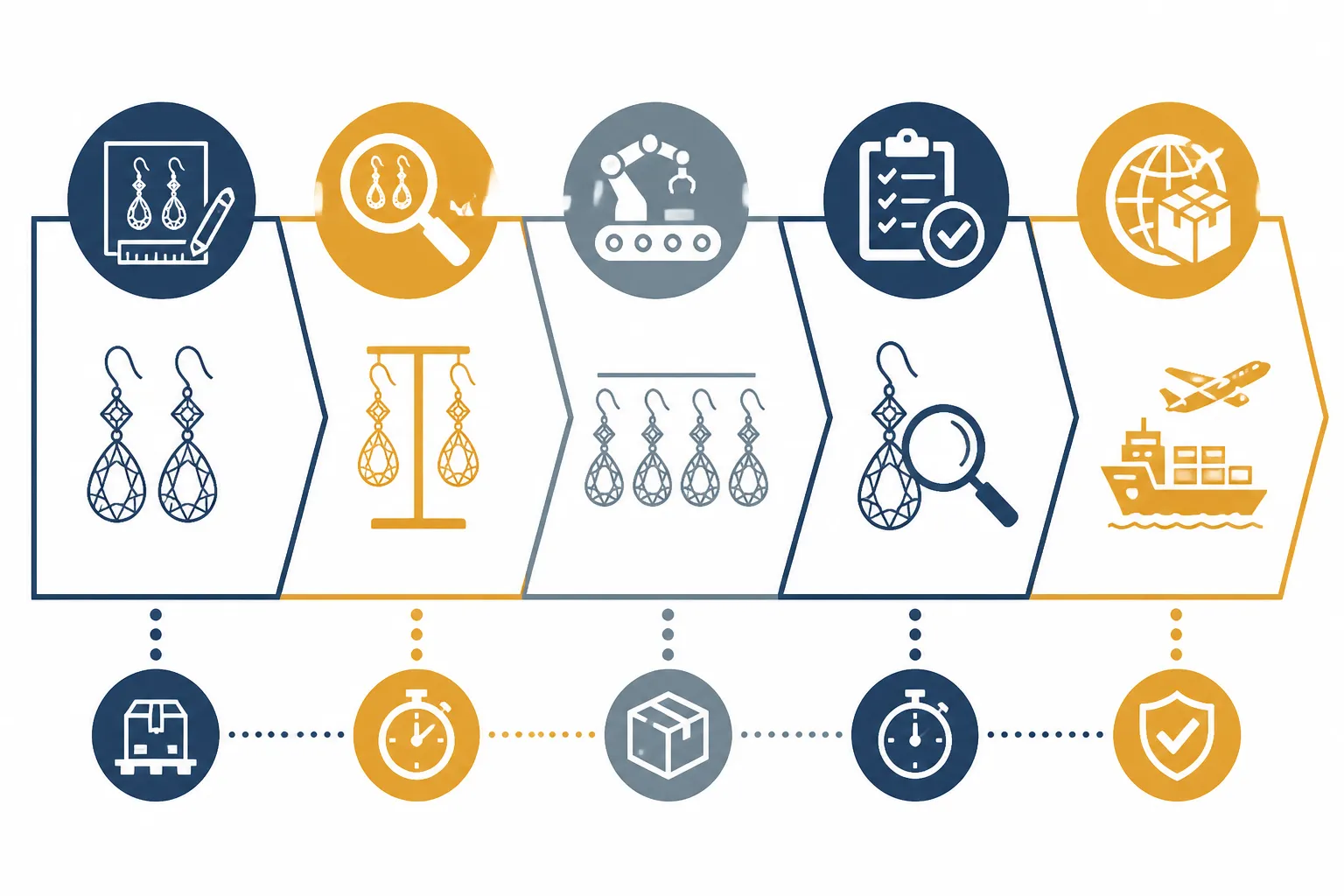
The specific problem: A brand or retailer wants to develop a private-label dangle earring collection — custom colorways, branded packaging, proprietary hardware finishes — without the factory minimums and communication barriers that typically make OEM inaccessible below enterprise scale.
How low-MOQ OEM addresses it: A supplier offering genuine OEM capability at commercially accessible minimums allows a mid-market brand to develop custom dangle earring styles — specific bead gradients, proprietary two-tone alloy combinations, branded card backings — without the unit economics of a large-format manufacturer. In-house product development support (tech pack review, prototype iteration) shortens the development cycle and reduces sample-round costs.
What success looks like: An OEM buyer completes a three-round sample process, approves a production sample within [lead time], and receives bulk goods with branded packaging ready for immediate retail deployment.
Example scenario: A Spanish-language DTC brand operating across Latin America and Spain develops a custom gradient crystal dangle earring line through a Hangzhou OEM partner, with full Spanish-language communication, and launches the collection under their own brand within a single season.
5. Multi-Channel Retailers Managing Platform Compliance
The specific problem: A retailer selling on Amazon US, Amazon EU, and their own Shopify store needs dangle earrings that satisfy platform-specific compliance requirements: Amazon's jewelry listing requirements, EU REACH regulations for nickel release, and US FTC guidelines on metal content representation. Sourcing non-compliant goods creates listing suppressions and potential import detention.
How compliant sourcing addresses it: A supplier who proactively provides material composition documentation, nickel-release test reports (to EN 1811 standard for EU), and accurate metal content language allows a multi-channel retailer to list accurately and confidently. Quality-vetted pre-shipment inspection reports provide a second line of defense against bulk production variation.
What success looks like: Zero listing suppressions due to compliance gaps. No returns attributable to misrepresented material content. Clean customs clearance on all shipments.
Example scenario: A US Amazon seller expands their dangle earring catalog to Amazon Germany, receives nickel-compliance test reports from their supplier for each SKU, and achieves a clean launch without a single ASIN suppression.
6. Boutique Buyers Replenishing High-Turn SKUs Quickly
The specific problem: An independent boutique or small chain has identified one or two dangle earring styles that sell consistently at retail and needs to replenish fast — without reordering a full seasonal assortment or waiting 60–90 days for a new production run.
How fast lead times and low MOQ address it: A supplier with standing production capacity for core dangle earring styles — classic crystal drops, simple glass bead dangles — can fulfill small replenishment orders quickly. Low MOQ thresholds allow a boutique to replenish a single winning SKU without meeting the minimums of a full seasonal order.
What success looks like: A boutique restocks its top-selling dangle earring within [lead time] days of identifying a stock-out risk, maintains in-stock rate on its highest-margin SKU, and avoids the revenue loss of a stockout during peak traffic periods.
Example scenario: A boutique in Austin identifies that its vintage crystal dangle earring has a two-week stock runway, places a replenishment order directly with their Hangzhou supplier, and receives QC-cleared goods before the stockout occurs.
Cross-Border Fashion Jewelry: Industry-Specific Considerations
Regulatory and Compliance
The regulatory landscape for dangle earrings varies significantly by destination market and cannot be treated as an afterthought. EU buyers must verify that earring alloys comply with REACH Regulation (EC) No 1907/2006, specifically Annex XVII restrictions on nickel release from post assemblies intended to be inserted into pierced ears (EN 1811 test standard). US buyers should ensure metal content representations comply with FTC guidelines on jewelry marketing. GCC buyers should confirm country-of-origin documentation meets Gulf Standardization Organization (GSO) requirements.
For plated earrings — the majority of fashion dangle earrings — plating thickness matters both for compliance representation and product longevity. Specifying micron thickness in your purchase order protects against flash-plating that fails quickly at retail.
Integration with Industry-Standard Procurement Workflows
Cross-border jewelry buyers increasingly manage sourcing through platforms like Alibaba Trade Assurance, direct factory relationships, or third-party sourcing agents. A supplier who can integrate with standard B2B procurement workflows — providing proforma invoices in standard formats, accepting LC and TT payment structures, issuing commercial invoices and packing lists in customs-compliant formats — reduces administrative friction significantly. For DTC operators using Shopify or WooCommerce, the ability to receive production photography and product data in formats ready for catalog upload accelerates time-to-market.
Data Sensitivity and IP Protection
OEM buyers developing proprietary dangle earring designs have legitimate IP concerns when working with Chinese manufacturers. Non-disclosure agreements (NDAs) and OEM agreements that explicitly address design ownership should be established before sharing tech packs or proprietary colorway specifications. Buyers should request that their custom designs are not offered to other customers — and should confirm this protection is formalized in the supplier agreement, not just verbally assured.
Scale and Seasonality
Fashion jewelry is among the most seasonally volatile product categories in retail. Dangle earring demand peaks sharply in Q4 (October–December), February (Valentine's), and April–June (spring/wedding season). Production capacity at Chinese workshops is constrained around Chinese New Year (typically late January to mid-February), which directly conflicts with Valentine's Day sourcing cycles. Buyers who plan production windows around the factory holiday calendar — placing orders by late November for Valentine's delivery, for example — consistently outperform buyers who discover the conflict after the window has closed.
Implementation Roadmap for Cross-Border Jewelry Teams
Building a reliable dangle earring sourcing channel from Chinese workshops is a phased process. Rushing to full-volume purchase orders without completing earlier validation steps is the most common and most expensive mistake buyers make.
Phase 1 — Pilot (Weeks 1–6)
- Define your dangle earring style brief: target retail price point, preferred materials (crystal, glass bead, rhinestone), hardware finish (gold-tone, silver-tone, two-tone), and destination market regulatory requirements.
- Request a sample set from your shortlisted supplier covering the styles closest to your brief. Evaluate against your retail photography standard, not just physical inspection.
- Conduct or commission a nickel-release or material compliance test on sample pieces if EU or UK distribution is planned.
- Place a pilot order at minimum MOQ to evaluate production consistency vs. approved sample, packaging quality, lead time accuracy, and communication responsiveness.
- Sell pilot inventory through your primary channel and track return rate by reason code.
Phase 2 — Department or Channel Rollout (Weeks 7–16)
- Based on pilot sell-through and return data, expand SKU count to 4–8 dangle earring styles.
- Negotiate a standing replenishment agreement covering core styles, with agreed lead times and MOQ thresholds.
- Integrate the supplier's production calendar into your seasonal buying calendar.
- Establish documentation standards for all incoming shipments: QC report, packing list, commercial invoice, and any market-specific compliance certificates.
- If launching OEM, initiate design development process: submit tech pack, receive first prototype, complete sample approval rounds.
Phase 3 — Full Program Deployment (Months 4–12)
- Expand to full seasonal assortment across dangle earring style families — vintage crystal, gradient bead, rhinestone statement, two-tone.
- Build a 60–90 day forward inventory buffer on top-performing SKUs to de-risk lead time and holiday season capacity constraints.
- Establish a formal supplier scorecard tracking on-time delivery rate, QC pass rate, and documentation accuracy.
- Evaluate adjacent categories (stud earrings, necklace + earring sets) for consolidation into a single supplier relationship to improve leverage and simplify logistics.
ROI and Business Outcomes for Cross-Border Jewelry Teams
The return on a well-executed dangle earring sourcing program is measurable across several dimensions that matter specifically to cross-border DTC and OEM buyers:
Gross Margin Improvement: Direct factory sourcing for dangle earrings — bypassing trading company intermediaries — typically delivers [X]% gross margin improvement on equivalent styles versus domestic wholesale. Buyers should model this against total landed cost including freight, duties, and compliance testing, not FOB price alone.
Return Rate Reduction: Pre-shipment QC inspection that catches plating defects, stone loss, or hardware failures before goods ship eliminates the return and replacement costs that erode margin on fashion jewelry. A move from 6–8% return rates (typical for non-QC-verified sourcing) to below 2% meaningfully changes the unit economics of a dangle earring program.
Time-to-Market Acceleration: Suppliers with established production capacity for core dangle earring styles and clear lead time commitments allow buyers to compress development cycles and respond to trend windows. Brands that can get from trend identification to live product within [lead time] days outperform competitors running 90-day sourcing cycles.
Inventory Efficiency: Low MOQ access to replenishment orders on winning SKUs reduces overstock risk on slower styles. Buyers who can reorder 50–200 units of a top-selling dangle earring without a full seasonal commitment improve inventory turn and cash conversion cycle.
Compliance Risk Elimination: A single ASIN suppression on Amazon or a customs detention event can cost multiples of the compliance testing investment. Buyers who systematize compliance documentation at the sourcing stage reduce this tail risk to near zero.
Conclusion: Next Steps for Cross-Border Jewelry Decision-Makers
Dangle earrings represent one of the highest-opportunity product categories in cross-border fashion jewelry — but only for buyers who approach sourcing with the rigor the category demands. Style range, photography performance, compliance by destination market, OEM customization, and lead time predictability are not independent variables. They need to be solved together by a supplier relationship built on transparency, communication, and verified quality.
STRAND is a Hangzhou-based brand purpose-built for this sourcing challenge. We connect US, EU, UK, and MENA buyers directly to vetted Chinese workshops producing drop earrings, stud earrings, and necklace + earring sets across vintage crystal, gradient glass bead, two-tone, and rhinestone styles. Our multilingual team — operating in English, Arabic, and Spanish — handles the full procurement workflow from sample request through pre-shipment QC and export documentation. OEM is available with low MOQ and defined lead times for buyers ready to build a private-label earring program.
Before you place your next dangle earring order, evaluate your current supplier on these dimensions:
- Can they provide nickel-release compliance documentation for EU distribution?
- Do they offer genuine low-MOQ OEM with custom packaging and branded hardware?
- Do they communicate proactively about production capacity around Chinese New Year and peak season windows?
- Is there an in-house QC step before goods ship — or are you the last line of inspection?
If any of those answers are unclear, it is worth getting a second opinion.
Submit your dangle earring brief — styles, quantities, destination market, and timeline — and our sourcing team will respond with MOQ options, pricing guidance, and lead time confirmation within one business day. Procurement teams with OEM requirements are welcome to share tech packs or reference images directly.
STRAND — Hangzhou-based. Globally sourced. Quality verified before it ships.