
Custom Jewelry vs. Ready-Made Wholesale: Which Sourcing Path Wins?
Custom Jewelry vs. Ready-Made Wholesale: Which Sourcing Path Wins?
TL;DR / Quick Verdict
If you're sourcing jewelry for a private label, building brand equity, or need differentiated SKUs that stock catalogs simply cannot offer, custom jewelry — particularly OEM production from vetted overseas workshops — delivers the flexibility, margin, and identity your business requires. Ready-made wholesale alternatives win on speed-to-market and zero design overhead, but they lock you into the same catalog every competing store is ordering from. The decision hinges on one question: are you building a brand or filling a shelf?
At-a-Glance Comparison Table
| Dimension | Custom Jewelry (OEM / ODM) | Ready-Made Wholesale Alternatives |
|---|---|---|
| Pricing model | Per-unit cost drops with volume; NRE/sampling fees upfront | Fixed catalog pricing; no NRE; higher per-unit at low volumes |
| MOQ | Varies by supplier; low-MOQ OEM partners available (e.g., STRAND) | Often 1 unit (dropship) to dozens per SKU |
| Lead time | 20–45 days typical (sampling + production) | 3–14 days (stock ready to ship) |
| Design ownership | Buyer-owned; exclusive SKUs; private label available | Shared catalog; no exclusivity |
| Branding options | Custom packaging, logo stamps, tags, color matching | Generic or co-branded at best |
| Style range | Limitless (within material capability) | Constrained to supplier's existing catalog |
| Quality control | Specifiable at contract level; in-house QC available | Fixed quality per catalog; limited recourse |
| Supplier communication | Varies; multilingual suppliers (EN/AR/ES) reduce friction | Usually English-only or platform-mediated |
| Certifications / compliance | Negotiable (REACH, RoHS, Nickel-free); request documentation | Supplier-dependent; often undocumented |
| Best for | DTC brands, private label importers, boutique retailers scaling | Fast-fill reorders, dropshippers, low-risk entry buyers |
Custom Jewelry Overview
Custom jewelry, in the B2B procurement context, refers to made-to-specification pieces produced at scale — either OEM (Original Equipment Manufacturing, where the buyer provides the design) or ODM (Original Design Manufacturing, where the supplier adapts or proposes designs). This is the sourcing model used by private label brands, boutique importers, and DTC store owners who need product that looks and feels like their product, not a shared catalog asset.
Who it's built for:
- DTC brands that compete on aesthetics and story, not price alone
- Importers supplying retail chains who require exclusive SKUs per account
- Boutique store owners in the US, EU, UK, and MENA who need differentiated inventory
- Procurement teams working with multilingual supplier relationships (Chinese, Arabic, Spanish-speaking markets)
Standout strengths:
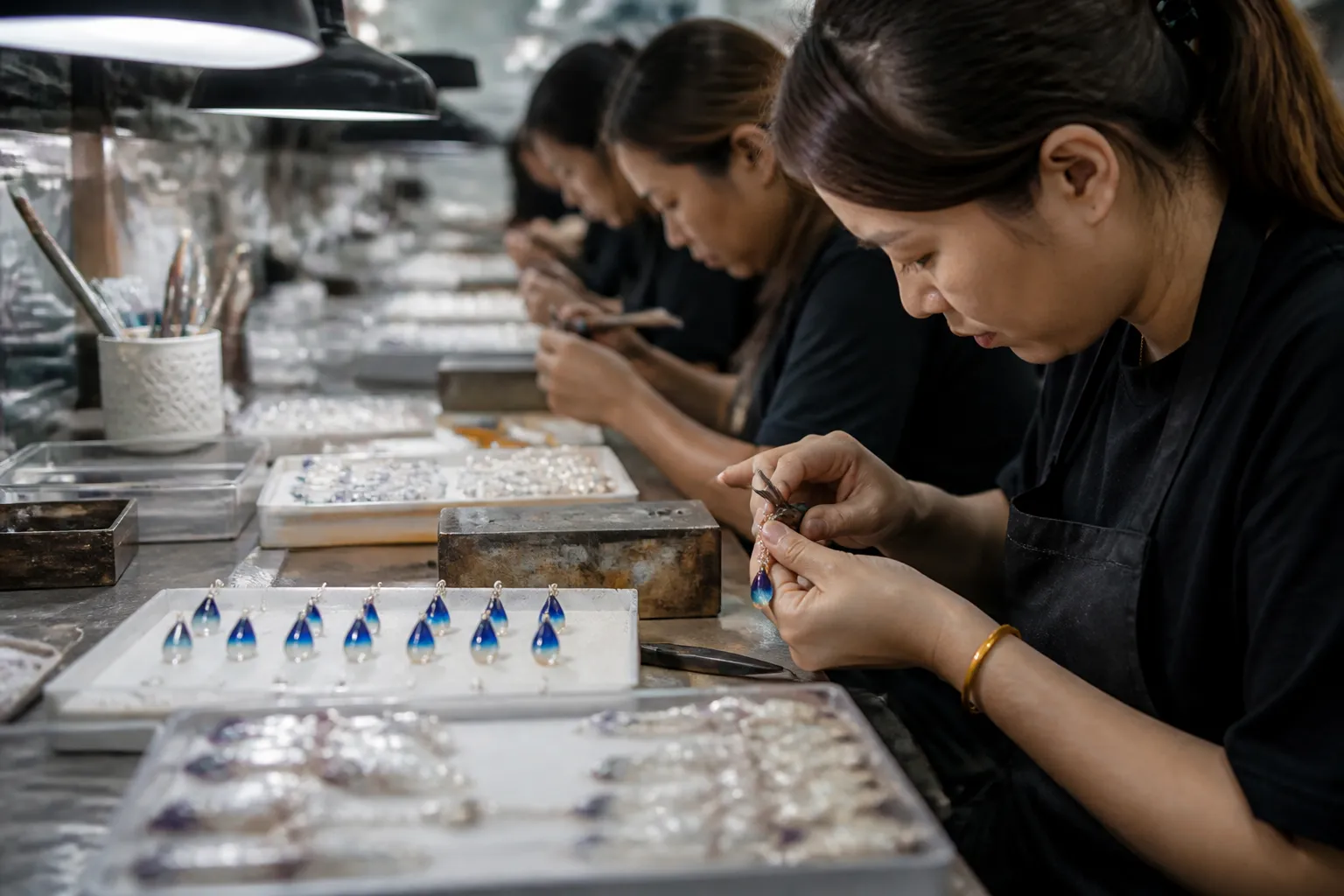
STRAND, a Hangzhou-based cross-border jewelry brand, represents the contemporary model: direct relationships with vetted Chinese workshops, in-house quality control before shipment, low MOQ thresholds relative to factory minimums, and multilingual support teams covering English, Arabic, and Spanish markets. Their product range — drop earrings, stud earrings, necklace-and-earring sets in vintage, gradient crystal, two-tone glass bead, and rhinestone styles — covers the high-velocity fashion jewelry categories Western buyers demand most.
The key differentiator of this model is transparency in trade terms combined with production flexibility. A buyer can specify gemstone color gradients, metal plating type (gold, silver, rose gold), packaging design, and country-of-origin documentation in a single purchase order — something no ready-made catalog can replicate.
Alternatives Overview
"Alternatives" in this context covers three common sourcing paths buyers consider before committing to custom production:
1. Ready-Made Wholesale Catalog Suppliers
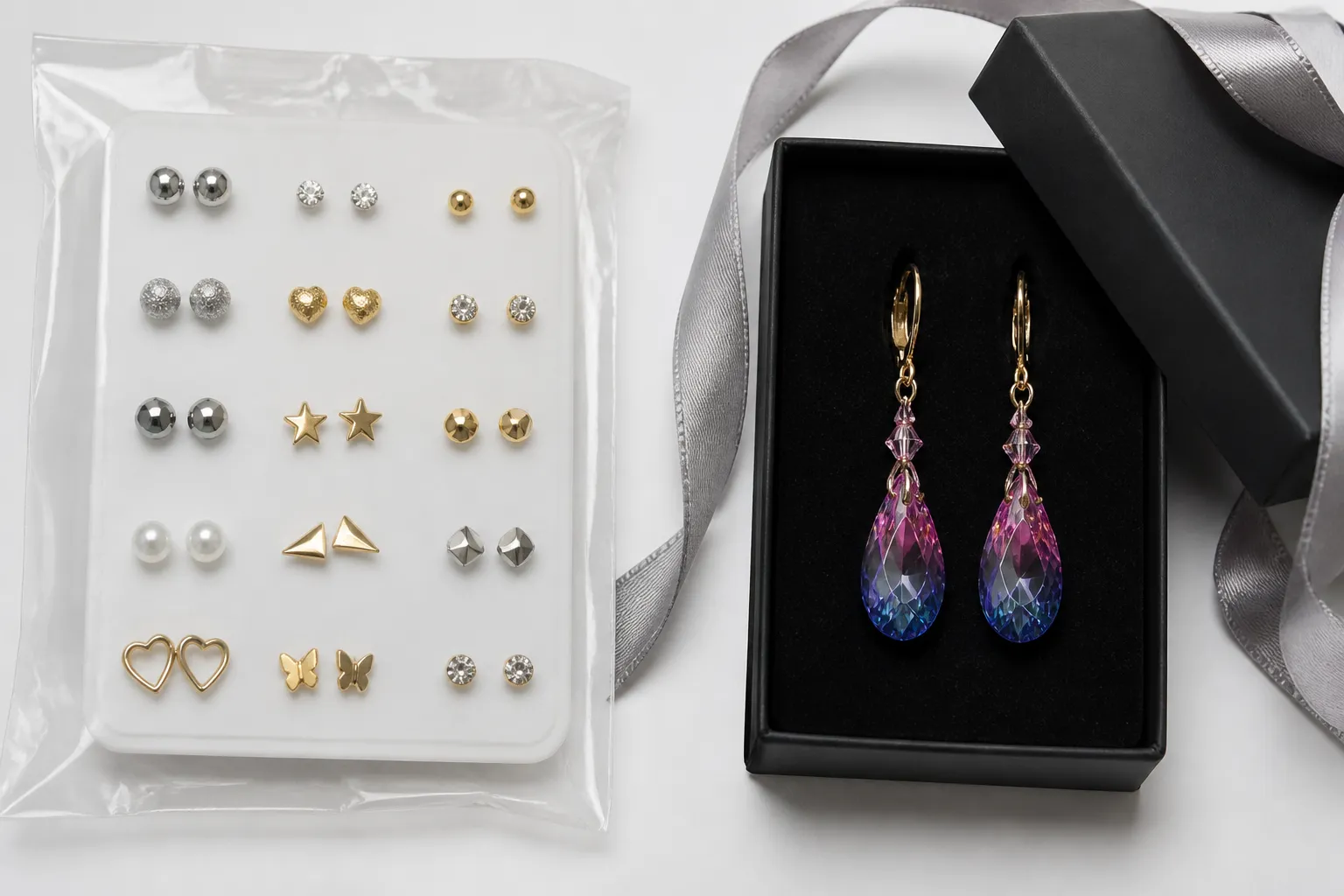
Platforms and wholesalers offering pre-manufactured jewelry that buyers select from existing inventory. Think Alibaba's RTS (ready-to-ship) listings, domestic US wholesale distributors, or dropship aggregators. The appeal is immediacy: no design work, no sampling round, no production lead time. The liability is sameness — if you're selling it, so are dozens of competitors in your market.
2. Domestic Custom Jewelers (US/EU-Based)
Local or regional artisan jewelers who take bespoke orders. Quality is often high and communication frictionless, but costs are substantially higher per unit and scale is limited. A domestic jeweler producing 50 units of a custom earring style is a boutique proposition, not a scaling one.
3. Generic Import Brokers / Sourcing Agents
Middlemen who purchase stock from Chinese factories and resell it, often without direct factory access. They offer some customization (private labeling, packaging) but without control over production quality, factory relationships, or material compliance documentation.
Feature-by-Feature Breakdown
Pricing and Cost Structure
Custom jewelry (OEM): Cost is driven by materials, complexity, plating, and volume. NRE (non-recurring engineering) costs cover tooling and sampling — typically a one-time investment that decreases effective per-unit cost as order volume grows. Buyers working with suppliers like STRAND benefit from transparent pricing structures and the ability to request formal quotations before committing. At scale, custom OEM is almost always cheaper per unit than domestic alternatives for equivalent quality.
Alternatives: Ready-made wholesale pricing is flat and predictable — no upfront fees, but no volume leverage beyond basic tiered discounts. Domestic custom jewelers price by labor hour and material; costs are 3–8× higher per unit than comparable OEM from China for fashion jewelry. Broker markups add 20–40% over direct factory pricing without adding service value.
Procurement takeaway: Request a formal quotation from any OEM supplier before comparing sticker prices. Ask for per-unit cost at 3–4 volume tiers, sampling fees, and packaging cost breakdowns separately.
Design Capability and Exclusivity
Custom jewelry (OEM): Full design ownership. Buyers can submit CAD files, mood boards, or reference samples; the manufacturer produces to spec. Leading suppliers offer in-house design assistance (ODM) — useful for buyers who know their market but lack technical drawing capability. Finished products are exclusive to the buyer, protected by NDA and non-compete clauses in the purchase agreement.
Alternatives: Ready-made wholesale carries zero exclusivity. Every competitor with a wholesale account has access to the same SKU. Some brokers offer private labeling (replacing hang tags), but the underlying product is identical across clients. Domestic artisan jewelers can create unique pieces, but at quantities under 100 units, the economics rarely support retail pricing.
Lead Time and Production Capacity
Custom jewelry (OEM): Initial sampling typically takes 7–14 days; bulk production runs 20–45 days depending on complexity and factory load. For fashion jewelry categories (earrings, pendant sets, beaded styles), well-organized suppliers with in-house QC — like STRAND's direct-workshop model — can compress timelines significantly compared to brokers who must relay instructions to factories they don't directly manage.
Alternatives: Ready-made stock ships in days. This is the most compelling advantage for buyers in reactive retail situations — a trend window, a pop-up event, a sudden reorder need. The trade-off is that when stock runs out, it runs out, and restocking the same SKU is supplier-dependent.
Quality Control and Compliance
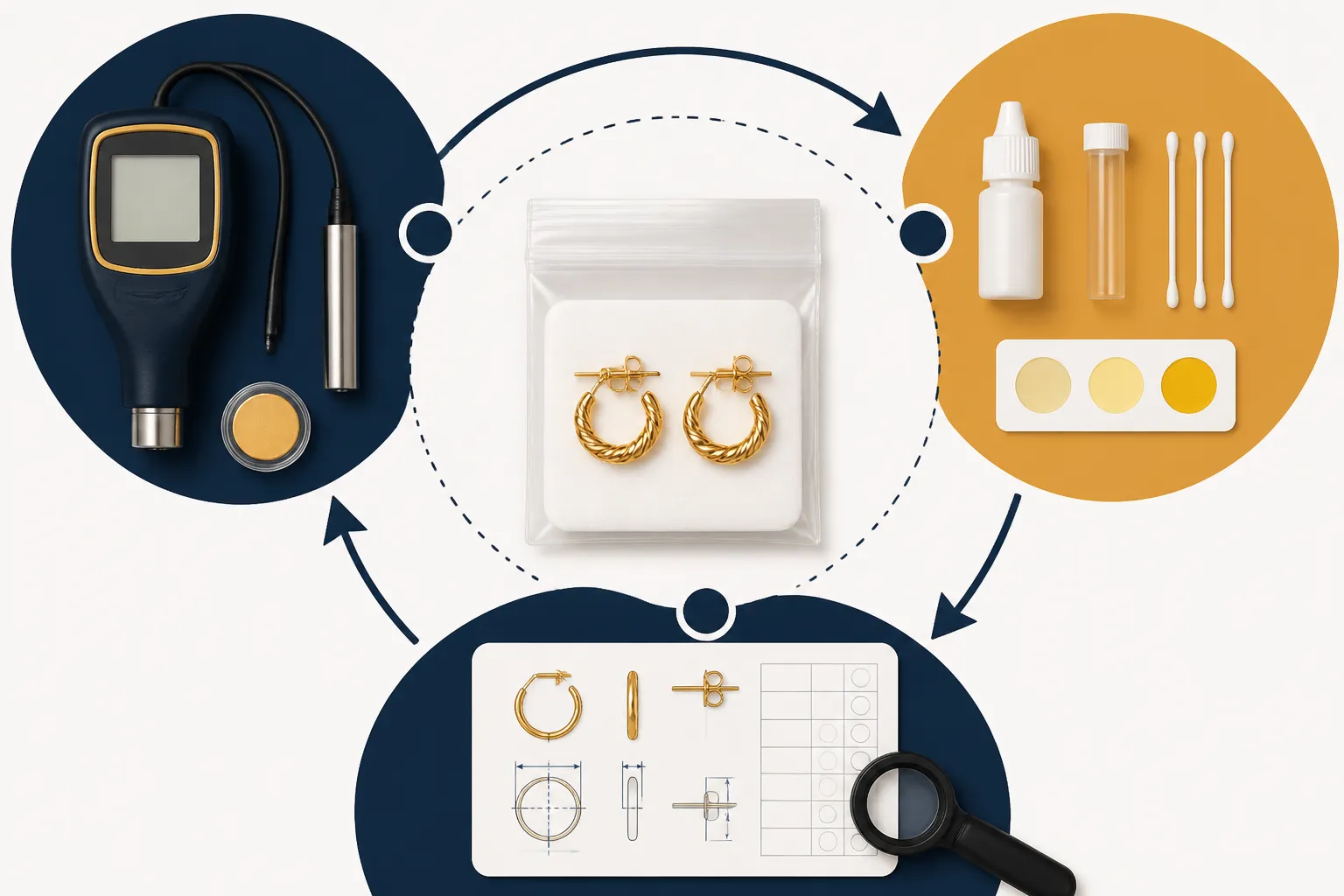
Custom jewelry (OEM): Quality is specifiable at contract stage — plating thickness, gemstone clarity grades, metal alloy composition, tarnish resistance standards. With suppliers like STRAND who perform in-house QC before shipment, defect rates are documented and recourse terms are negotiable upfront. Buyers sourcing for EU or UK markets should ask specifically about REACH and RoHS compliance documentation, nickel-release test reports, and California Prop 65 compliance for US sales.
Alternatives: Ready-made wholesale quality is fixed and undocumented in most cases. Catalog listings rarely include material certifications, plating thickness specifications, or compliance reports. Defects found post-delivery are handled through return/replacement policies that vary widely. Domestic artisan jewelers offer high quality assurance but cannot easily provide the formal compliance documentation B2B buyers in regulated markets require.
Communication and Supplier Reliability
Custom jewelry (OEM): The largest operational friction point in China-based sourcing has historically been communication — time zones, language barriers, and unclear trade terms. Suppliers who address this directly — STRAND provides multilingual service in English, Arabic, and Spanish, with transparent Incoterms and payment schedules — substantially reduce the project management burden for overseas procurement teams. Evaluate response time, sample turnaround, and willingness to provide factory audit documentation before committing.
Alternatives: Domestic suppliers and ready-made platforms communicate in the buyer's language and timezone without friction. Wholesale platforms often have standardized return and dispute processes. The reliability trade-off is that neither delivers the branded product outcome that OEM does.
Scalability
Custom jewelry (OEM): Scales in both directions — low-MOQ suppliers allow DTC brands to test styles before committing to large runs, while established factories can fulfill tens of thousands of units within a single production cycle. Private label buyers benefit from locked-in pricing and design assets that scale without renegotiation.
Alternatives: Dropship/wholesale scales easily to the downside (individual units) but hits catalog ceilings quickly — if a style sells out or is discontinued, the product line dies with it. Domestic jewelers are capacity-constrained and rarely suited to orders above 200–500 units per style.
Pros and Cons
Custom Jewelry (OEM / ODM)
Pros:
- Full design ownership and brand exclusivity
- Lower per-unit cost at scale vs. all alternatives
- Specifiable quality standards and documented QC
- Flexible packaging, branding, and labeling
- Compliance documentation available on request
- Low-MOQ suppliers (like STRAND) reduce entry risk
- Multilingual support reduces procurement friction for non-English teams
Cons:
- Upfront sampling costs and lead time before first delivery
- Requires more procurement management (specs, approval rounds)
- Quality outcome depends on supplier selection and QC rigor
- Wire transfer / trade finance risk with unknown suppliers
- Time zone coordination needed for China-based production
Ready-Made Wholesale Alternatives
Pros:
- Immediate availability; ships in days
- No design work or sampling required
- Low entry commitment; test products without investment
- Familiar platforms with dispute resolution processes
- No language or timezone friction (domestic/platform-based)
Cons:
- Zero exclusivity — competitors stock identical products
- No branding or packaging control (beyond basic labeling)
- No quality specification leverage; catalog quality is fixed
- Margin compression as product is commoditized across sellers
- Compliance documentation often absent
- Cannot scale into private label without switching supplier model entirely
When to Choose Custom Jewelry
Scenario 1: You're launching a private label brand. If your growth strategy depends on product identity — a recognizable aesthetic, your own packaging, repeat customers recognizing "your" earring style — ready-made wholesale will never get you there. OEM is the only path to a defensible product.
Scenario 2: You're supplying a retail chain with account-exclusive SKUs. Major retailers often require supplier exclusivity agreements. Custom production is the only way to fulfill those terms legitimately.
Scenario 3: You're importing for MENA, EU, or UK markets with compliance requirements. REACH, RoHS, and nickel-release regulations in the EU and UK require documentation that only a properly structured OEM relationship can provide reliably.
Scenario 4: You're a DTC store owner scaling past $200K/year in jewelry revenue. At that volume, catalog products are a margin leak. OEM unit economics justify the switch, especially with low-MOQ partners who reduce the minimum commitment.
Scenario 5: You have multilingual procurement teams or operate in Arabic/Spanish-speaking markets. Suppliers with native multilingual support — not translated auto-responses — eliminate costly miscommunication in specification rounds.
When to Choose Alternatives
Scenario 1: You need product in under two weeks. If you have a pop-up, a seasonal sell window, or a reorder emergency, ready-made stock is the only viable answer. No OEM supplier can compress sampling and production into that timeline.
Scenario 2: You're testing a new product category with under $5,000 in initial inventory budget. The economics of OEM (sampling, tooling, minimum run) may not pencil out until you've validated the category. Start with ready-made, prove demand, then convert to OEM.
Scenario 3: You sell one-of-a-kind or truly bespoke pieces to individual consumers. Domestic artisan jewelers or in-house designers are the right fit. OEM is a production model, not a craft model.
Scenario 4: You have no design capability and no brand differentiation thesis. If price and availability are your only competitive levers, catalog wholesale with dropship fulfillment may match your actual business model better than OEM.
Final Verdict
The custom jewelry vs. alternatives decision is not a close call for most B2B buyers at the decision stage — it is a business model question.
If you are building a brand, supplying exclusive retail accounts, or operating in regulated import markets, ready-made wholesale cannot serve your requirements. The unit economics, compliance posture, and brand equity of OEM custom jewelry are simply in a different category. The barrier — upfront sampling, lead time, specification management — is manageable with the right supplier partner.
The supplier selection variable matters enormously. A China-based OEM partner with direct factory relationships, in-house QC, multilingual procurement support, and transparent trade terms (like STRAND's model connecting Hangzhou workshops directly to overseas buyers) removes the three largest failure modes in cross-border sourcing: communication breakdown, quality surprise, and compliance gap.
Ready-made alternatives are the right choice exactly once: when you are testing a new market and cannot afford to wait for production. Use that window to validate the category, then convert to OEM with a supplier who can grow with you.
Ready to Source Custom Jewelry for Your Business?
If you're evaluating OEM production for drop earrings, stud earrings, crystal bead sets, or rhinestone styles — or need a supplier who can serve multilingual procurement teams across US, EU, UK, and MENA markets — STRAND's team is available to walk through your requirements.
What to have ready when you reach out:
- Style references or mood board
- Target markets and any applicable compliance requirements (EU REACH, UK PHTHALATES, etc.)
- Estimated annual volume or initial order quantity
- Packaging and branding requirements
- Preferred Incoterms (FOB / CIF / DDP)
Request a Quote or Get MOQ & Pricing → strandjewelry.com
Last reviewed: July 2026. Pricing tiers, lead times, and MOQ thresholds vary by product and order configuration — request a formal quotation for accurate figures specific to your sourcing requirements.