
Custom Jewelry vs. Stock Wholesale: What B2B Buyers Need to Know
Custom Jewelry vs. Stock Wholesale: What B2B Buyers Need to Know
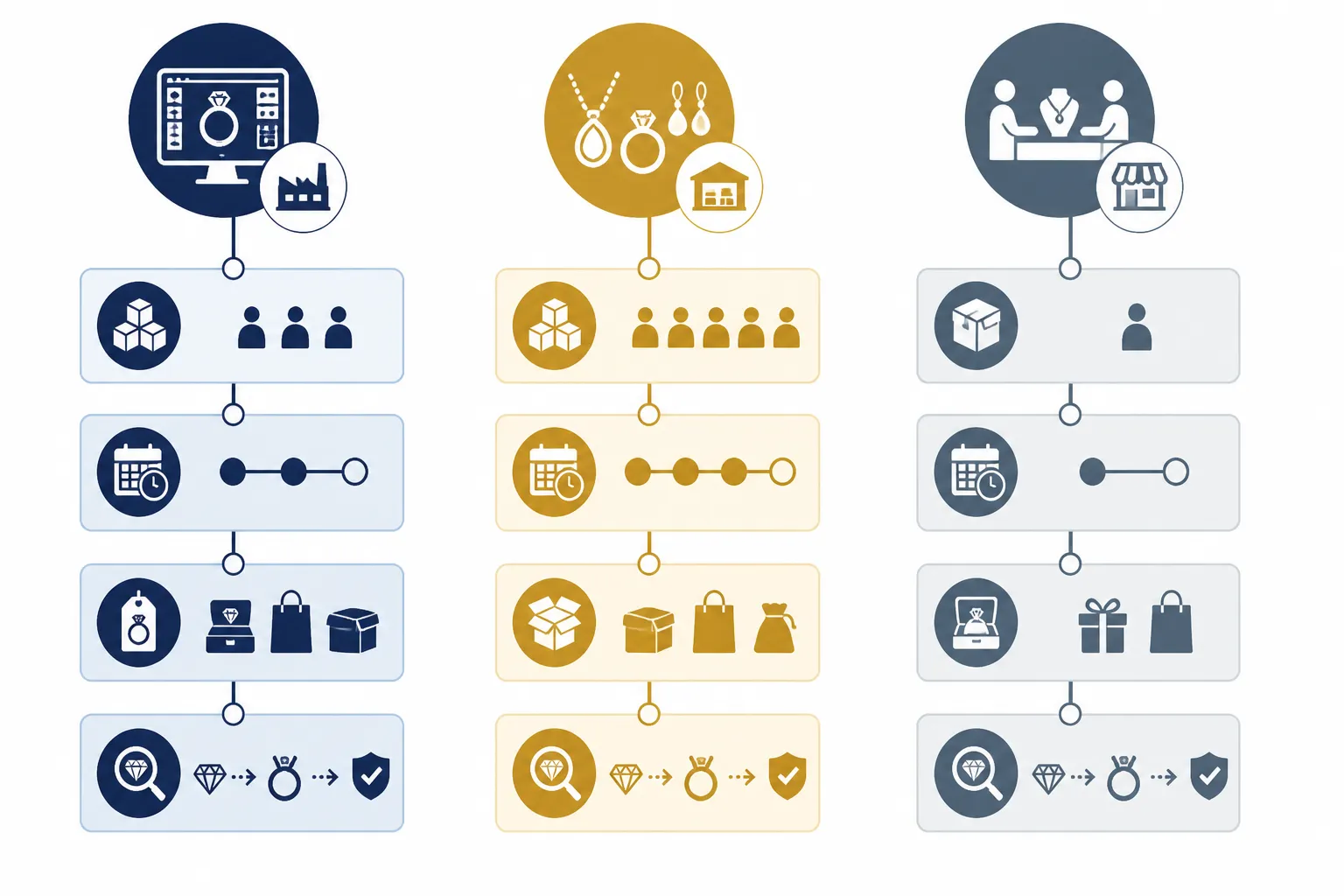
Custom OEM jewelry gives your store a differentiable catalog no competitor can replicate overnight. The alternatives—stock wholesale, generic dropship catalogs, or consumer-facing custom services—trade that differentiation for speed or lower commitment, and which trade-off fits depends on your scale, brand strategy, and how much margin you're willing to leave on the table.
TL;DR / Quick Verdict
Custom OEM jewelry is the right move for DTC brands and importers who need branded, exclusive designs at repeatable scale. Stock wholesale wins on speed and low financial risk for buyers testing a new product category. Consumer-oriented custom jewelry services—retail configurators and in-store design centers—serve end shoppers well, but they are not built for the procurement realities of B2B importers sourcing at volume.
At-a-Glance Comparison Table
| Dimension | Custom OEM Jewelry | Stock Wholesale | Retail Custom Services |
|---|---|---|---|
| Design control | Full (spec-to-sample) | None (catalog only) | Limited (preset menu) |
| MOQ structure | Per-style (varies by supplier) | Per-order minimums or pre-packed | N/A — consumer unit pricing |
| Lead time | Longer (sampling + production) | Short (in-stock ships fast) | Days to weeks per piece |
| Brand exclusivity | Full private label / OEM | Generic, shared with all buyers | Consumer name/engraving only |
| Price per unit | Lowest at scale (factory-direct) | Moderate (catalog markup) | Highest (retail margin) |
| Scalability | High | Moderate | Not B2B-scalable |
| QC location | Supplier-side (pre-shipment) | Buyer-side (on receipt) | Retail-side (consumer-facing) |
| Best fit | DTC brands, importers, private label | Small retailers, quick-start | End consumers |
Custom Jewelry: What It Actually Means for B2B Buyers
Custom jewelry in a B2B context is not about engraving a name on a pendant. It means working with a manufacturer to develop pieces built to your specifications—your metal finish, your stone selection, your SKU design, your packaging—produced under your brand or private label. This is OEM territory. The supplier makes to your design brief or adapts existing molds to your requirements. The output is a product no other retailer carries under the same specification.
For fashion jewelry specifically—earrings, necklace sets, bead and crystal styles—custom OEM creates meaningful differentiation. You control the colorway (gradient crystal vs. two-tone glass bead vs. rhinestone). You control the plating (gold-plated vs. rhodium-plated copper). You control the style mix within your initial order run. That level of control separates a brand from a reseller.
STRAND operates in this space as a Hangzhou-based manufacturer connecting overseas buyers directly to vetted Chinese workshops. Their stock catalog runs 114 styles—drop earrings, stud earrings, necklace-and-earring sets across vintage, gradient crystal, two-tone glass bead, and rhinestone aesthetics—with 109 of those 114 styles available at 12 pcs/style MOQ. Select styles can be ordered from a single piece, which is useful for sampling and small-run testing. Custom OEM is available in gold-plated and rhodium-plated copper, 925-style silver finishes, glass beads, natural stone, and faux pearl materials. Sales teams operate in six languages (EN, FR, AR, ES, DE, RU)—a practical differentiator for multilingual procurement teams working across MENA, EU, and US markets simultaneously.
Custom jewelry sourcing at this level requires planning: sampling rounds, production lead times, and shipping decisions between EXW and FOB. The trade-off is a catalog that is actually yours.
Alternatives Overview: Stock Wholesale, Generic Platforms, and Retail Custom Services
The alternatives to custom OEM jewelry fall into three distinct buckets, each with a different risk-reward profile.
Stock wholesale sourcing means buying from a supplier's existing inventory without design input. You pick from what's available, delivery is faster, and there is no sampling phase. The downside: every other buyer using the same supplier is potentially selling identical products. Price competition on shared SKUs is structural, not situational.
Generic B2B platforms and dropship catalogs (aggregator trading sites) offer the widest SKU selection but the least supplier accountability. Quality control is buyer-managed on receipt. Many importers start here to validate category demand before committing to OEM development—a reasonable use case, provided you treat it as a testing phase.
Retail-oriented custom jewelry services occupy a completely different category and are worth understanding even if you won't use them directly. Services like Kay Jewelers' in-store Custom Design Center are consumer experiences—not procurement channels. Kay's ring configurator, for instance, lets shoppers choose from nine center stone shapes (Princess, Round, Oval, Pear, Emerald, Marquise, Cushion, Radiant, and Heart) and carat ranges from 1 through 7, and the service includes lab-grown diamond options alongside natural stones. The consumer experience is polished. But the pricing is retail, the model assumes a single buyer, and there is no B2B procurement interface—no bulk pricing, no OEM terms, no private label capability.
Some DTC store owners scan these retail services for trend signals—understanding what consumers currently choose in personalized fine jewelry—but sourcing product through them at scale is not viable.
Feature-by-Feature Breakdown
MOQ and Order Flexibility
Custom OEM manufacturers typically set minimums per style, not per total order value. STRAND's 12 pcs/style minimum across 109 of its 114 catalog designs lets importers build a diversified opening order—10 different earring styles at 12 units each (120 pcs total) rather than committing 120 units to a single SKU. That structure is practical for buyers managing multi-SKU catalogs across multiple markets, because it lets you test several styles before scaling the winners. The 1-piece minimum on select styles is specifically useful during the sampling phase before committing to a production run.
Stock wholesale suppliers more often require minimum order values than per-style unit counts, which can push buyers toward fewer SKUs in higher quantities—fine if you know what sells, risky when testing new categories. Generic platforms vary. Retail custom services have no relevant MOQ concept.
Pricing and Cost Structure
Custom OEM pricing is factory-direct. You pay for material, labor, plating, and a manufacturer margin—without the markup layers that wholesale distributors or retail brands add. At equivalent volumes, this is the lowest cost-per-unit path for branded fashion jewelry.
Stock wholesale runs higher per unit than OEM at comparable quantities, because you are buying a supplier's pre-built inventory that already carries their margin. The convenience is priced in. Retail custom services are priced for individual consumers—a one-off purchase at full retail rates, structurally incompatible with import economics.
One caveat that applies across all three paths: request itemized quotes and ask what's included (sampling fees, pre-shipment QC inspection, packaging, freight to port). Headline per-unit prices diverge significantly from landed cost. Compare on landed cost, not catalog price.
Design and Customization Depth
This dimension creates the clearest separation between options. A custom OEM partner lets you modify existing molds, propose original designs, select specific stone colors and cuts, specify plating finish, and design packaging—producing a SKU that exists only in your catalog.
Stock wholesale gives you zero design input. Your competitors have equal access to every item you order. For fashion jewelry with aesthetic-driven consumer demand—where gradient crystal earrings in a specific colorway are a seasonal sell-through driver—carrying the same piece as five other stores destroys pricing power.
Retail custom services offer menu-based customization within the retailer's preset options. The degree of "custom" is controlled by the seller's configuration tool, not by the buyer's design brief. For DTC store owners building a brand around specific aesthetics—vintage crystal, two-tone glass bead, rhinestone gradient—the gap between owning your spec and reselling someone else's catalog is the gap between a brand and a drop-shipper.
Quality Control and Compliance
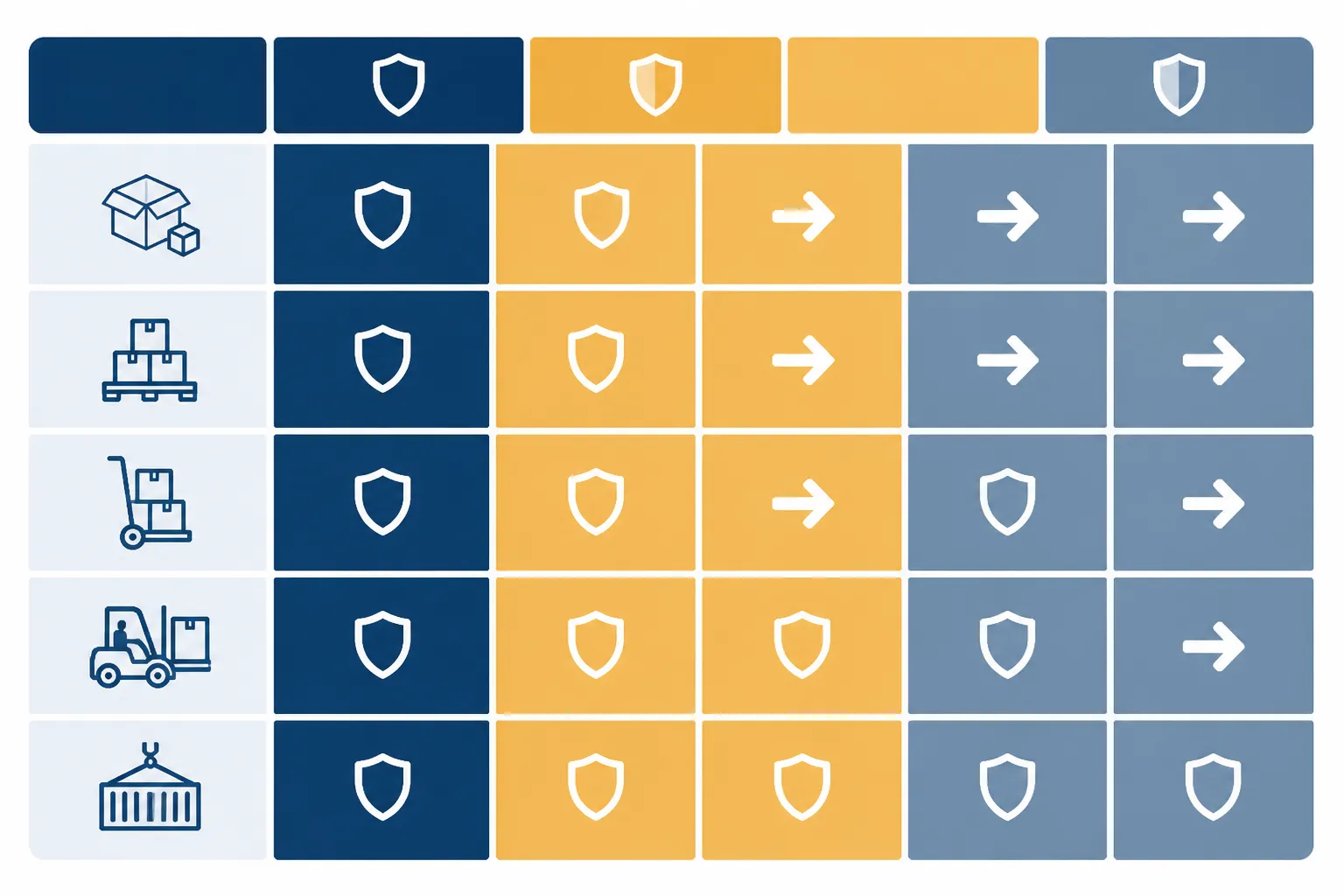
QC in custom OEM sourcing depends entirely on the supplier's process. The right question isn't "do they do QC?"—it is "at what point in production, what's inspected, and what's documented?" Pre-shipment inspection that checks plating adhesion, clasp function, stone security, and packaging integrity catches problems before they become landed returns.
STRAND runs in-house QC inspection before every shipment—a specific checkpoint, not a general policy statement. For importers shipping to the US and EU, where consumer safety standards (REACH compliance for nickel content, CPSC regulations, EU Toy Safety Directive for accessories) are enforced, knowing your supplier inspects before dispatch—not after it leaves the country—matters for your own compliance position.
Stock wholesale and platform-based sourcing shifts QC responsibility to the importer. You inspect what you receive, not what leaves the factory. That's a meaningful operational difference when your landed defect rate affects customer returns and marketplace seller ratings.
Lead Time and Production Capacity
Custom OEM carries longer lead times than buying from stock. Sampling rounds—reviewing proto samples, requesting adjustments, approving production samples—add weeks before production begins. For fashion jewelry in plated copper and glass beads (rather than fine jewelry requiring certified gemstones), production cycles are shorter than precious metal categories, but buyers should still plan for considerably more runway than a stock order requires.
Stock sourcing from a supplier with warehouse inventory can fulfill and ship within days to a few weeks depending on trade terms and logistics routing.
For importers managing seasonal inventory cycles—spring launches, holiday restocks, MENA-market Eid collections—working with a custom OEM partner requires building a forward calendar of 90 to 120 days for new SKU development. Stock purchasing fills gaps and responds to short-term demand spikes. The two approaches work better together than in competition.
Payment and Trade Terms
Payment flexibility is a concrete procurement criterion in cross-border sourcing. Wire transfers, letters of credit, and platform-based payment methods each carry different risk profiles depending on order size and buyer-supplier relationship history.
STRAND accepts T/T bank transfer, Western Union, PayPal, L/C, and Xtransfer, with EXW or FOB trade terms and shipping available by air, sea, or express. That range covers most buyer situations—PayPal for small initial orders where the buyer wants payment protection, L/C for larger shipments where formal documentation reduces risk for both parties, Xtransfer for buyers in markets where standard wire transfers are slower or subject to FX friction.
Generic platforms default to escrow. Retail custom services use consumer payment rails entirely—no trade terms, no LC framework, no B2B invoicing.
Pros and Cons
Custom OEM Jewelry
Pros
- Exclusive designs—competitors cannot list identical products
- Factory-direct pricing improves margin at scale
- Full control over materials, finishes, packaging, and brand presentation
- Scalable from sample run to large-volume reorders
- Pre-shipment QC reduces landed defect rate
- Multilingual support available from established suppliers serving global markets
Cons
- Longer lead times due to sampling and production phases
- Requires upfront design commitment and planning capacity
- Per-style MOQ still applies, even at accessible thresholds
- Supplier relationship quality varies; vetting is the buyer's responsibility
Stock Wholesale and Alternatives
Pros
- Immediate availability from existing inventory
- No sampling phase—faster time to shelf
- Lower initial financial commitment for category testing
- Useful for filling inventory gaps while custom production is in progress
Cons
- Zero design differentiation—same SKUs available to all buyers using the same supplier
- Per-unit cost is higher than OEM at comparable volumes
- No private label or brand exclusivity possible
- QC at destination rather than at origin
When to Choose Custom Jewelry
You're building a brand, not running a catalog store. If your DTC store competes on aesthetic identity—a specific color palette, a vintage-crystal earring signature, a curated bead set story—you need pieces that belong to that brand. Stock catalog items do not.
Your markets penalize non-exclusive product. US and EU buyers on multi-channel platforms face product matching and margin compression on generic SKUs. Marketplace algorithms surface the cheapest listing; custom OEM removes your product from that comparison entirely.
You have the buying calendar for OEM lead times. If your procurement process supports 90–120 day horizons for new SKU development, and you have a design direction to brief a manufacturer, custom OEM is the highest-margin path forward.
You source across multiple regions with different sales languages. Importers serving the US, EU, and MENA simultaneously benefit from a manufacturing partner with multilingual support. Briefing in Arabic or French rather than translating back into English speeds sample approval rounds meaningfully.
When to Choose Alternatives
You're entering a new category and need demand validation. Ordering stock pieces at lower financial commitment lets you test consumer response before investing in OEM development costs. Use that sales data to brief your first custom run with confidence.
Your restock cycle is too short for OEM lead times. If you need product on shelf within three weeks, stock wholesale is your only viable option. Custom OEM is not a fast replenishment channel—it is a brand-building channel.
Your volume doesn't yet justify OEM development overhead. For very small operations still building order scale, the economics of custom sampling and tooling may not pencil out until you've grown the business. Start with stock, build volume, then commission custom when the reorder pattern supports it.
You're buying for a one-time campaign or event. Pop-up retail, event-specific merchandise, or short-run promotional pieces don't require brand exclusivity. Stock wholesale is faster and cheaper when exclusivity is not the goal.
Final Verdict
The sourcing decision is not really "custom vs. not custom." It is "what stage is your business at, and what are you building toward?"
Stock wholesale is a starting point, not a strategy. It validates demand and fills gaps, but it does not build a brand. Retail custom jewelry services—like Kay Jewelers' Custom Design Center—serve a completely different buyer: the end consumer purchasing a personalized piece for themselves or as a gift. They are not procurement channels, and treating them as benchmark competitors to an OEM manufacturer misreads the market.
Custom OEM jewelry—working with a manufacturer who builds to your spec, runs QC before shipment, and ships on trade terms you control—is the path for importers and DTC operators building defensible margin and catalog exclusivity. The supplier you choose matters as much as the model itself. Verify MOQ structure per style (not just per order total), confirm QC is pre-shipment and documented, and establish that payment terms match your treasury process before placing a first order.
If you're sourcing fashion jewelry—earrings, sets, crystal and bead styles for US, EU, or MENA markets—and ready to move from catalog dependency to branded product development, the next step is a sample conversation.
Request a quote or OEM sample brief at strandjewelry.com—include your target styles, preferred finishes, and market destination to get MOQ and pricing specific to your order profile.