
14k Gold Stud Earrings: Buyer's Guide for U.S. Retailers & Brands
14k Gold Stud Earrings: Buyer's Guide for U.S. Retailers & Brands
14k Gold Stud Earrings in the United States — Market Overview
The United States remains one of the world's largest and most dynamic markets for fine and fashion jewelry, with gold jewelry holding a central position in consumer spending year-round. Within that landscape, 14k gold stud earrings occupy a particularly resilient niche: they are the default "everyday fine jewelry" purchase for millions of American consumers, spanning gift-giving occasions from Sweet Sixteens to anniversaries, as well as ongoing self-purchase by working adults who want understated, wearable pieces. Industry estimates suggest that stud earrings consistently rank among the top three best-selling earring categories in the U.S. by unit volume, driven by their versatility and approachability across age groups and income levels.
Demand drivers in the U.S. market are multi-layered. On the consumer side, the continued popularity of ear stacking — wearing multiple earrings across the lobe and cartilage — has expanded the average per-customer unit count. A shopper who once bought one pair of studs now buys three or four, mixing gold ball studs with gemstone accents and minimalist geometric shapes. Social media platforms, particularly TikTok and Instagram, have accelerated trend cycles and broadened exposure to styles that were once niche. On the trade side, the post-pandemic DTC (direct-to-consumer) boom has created thousands of new small jewelry brands operating through Shopify storefronts, Etsy shops, and boutique wholesale networks — all of whom need a reliable supply of quality gold studs at competitive landed costs.
Buyer profiles in the U.S. span a wide spectrum. At one end are established brick-and-mortar jewelers and regional chains sourcing in bulk for predictable seasonal inventory. At the other are emerging DTC brand founders who may be ordering hundreds of units per SKU rather than thousands but who demand the same level of quality documentation and customization as larger players. In between sit importers and wholesale distributors who act as intermediaries between overseas manufacturers and domestic retailers. All three profiles share a common pressure point: balancing the demand for genuine 14k gold quality (not gold-filled, not gold-plated) against a U.S. retail price point that consumers will actually convert on.
What's Specific About the United States
Regulatory & Compliance Environment
The U.S. has specific federal and state-level frameworks that any buyer of 14k gold stud earrings must understand before importing or retailing.
Karat Marking Requirements: The Federal Trade Commission (FTC) governs jewelry quality representations under its Guides for the Jewelry, Precious Metals, and Pewter Industries (16 CFR Part 23). Under these guides, any piece sold as "14k gold" must be within half a karat of that stamp — meaning 14k items must be at least 13.5 karats. Sellers are required to disclose the karat fineness. Products imported from overseas must comply with these guides upon sale in the U.S., not just upon import, so buyers sourcing from Chinese manufacturers need confirmed hallmarking on each piece.
Nickel & Allergen Regulations: Unlike the EU, which enforces strict nickel release limits under EU Regulation 1907/2006 (REACH), the U.S. does not have a federal nickel restriction for jewelry. However, California's Proposition 65 (Safe Drinking Water and Toxic Enforcement Act) lists cadmium and lead as chemicals requiring consumer warnings, and several states have passed or proposed legislation targeting heavy metals in children's jewelry. Buyers selling into California specifically — or retailers with a national footprint — should request third-party heavy metal testing reports (typically from SGS, Bureau Veritas, or Intertek U.S. labs) from any overseas supplier.
CPSC Regulations: The Consumer Product Safety Commission (CPSC) has jurisdiction over children's jewelry. If any stud earring product is marketed for children under 12, lead content must comply with CPSC limits (100 ppm lead in substrate). For adult jewelry marketed as 14k gold, CPSC regulations are less prescriptive, but importers remain liable for products that cause consumer harm.
Customs & Import: 14k gold jewelry is classified under HTS Chapter 71. Importers should be prepared for CBP (U.S. Customs and Border Protection) scrutiny on country of origin marking (items must be marked "Made in China" or equivalent), proper invoicing, and valuation. Working with a licensed customs broker is standard practice for any repeat importer.
Cultural & Consumer Norms
American consumers place significant weight on the "14k gold" designation as a trust marker distinguishing "real" jewelry from costume jewelry. The 14k standard — rather than the 18k preferred in European and Middle Eastern markets — dominates U.S. retail because it offers a durable, affordable middle ground. Yellow gold has seen a strong revival since roughly 2018 after decades of white gold dominance; rose gold remains popular with younger demographics; two-tone designs are gaining share.
Gift-giving seasonality is pronounced: Valentine's Day, Mother's Day, and the winter holiday season (Thanksgiving through New Year) are peak demand periods, with back-to-school and graduation (May–June) also generating meaningful spikes in stud earring sales.
Payment Methods & Trade Terms
For domestic B2B transactions, Net 30 or Net 60 terms on invoice are standard among established wholesale relationships. For new import relationships with overseas suppliers, U.S. buyers typically negotiate via T/T (wire transfer) with a deposit (30–50%) on order and balance against shipping documents, or through letters of credit (LC) for larger orders. PayPal Business and trade finance platforms (e.g., Alibaba Trade Assurance) are increasingly common for smaller orders. Credit card acceptance via international gateways is now expected by smaller DTC buyers who want purchase protection.
How to Choose a 14k Gold Stud Earrings Provider in the United States
Selecting a supplier — whether domestic or overseas — for 14k gold stud earrings requires evaluating several dimensions specific to the U.S. procurement environment.
Karat Authenticity Verification
Request a metal assay certificate or third-party testing report confirming the gold content of samples before placing a production order. Reputable suppliers will have these available or will agree to pre-production assay at a certified U.S. or internationally recognized lab. This is non-negotiable for brands selling into the U.S. market given FTC karat disclosure requirements.
Allergen & Safety Documentation
Ask for a Restricted Substances List (RSL) test report covering lead, cadmium, and nickel. For California-bound product, request a Prop 65 compliance statement. These documents protect you from downstream liability and are increasingly required by U.S. retail buyers (Amazon, Nordstrom, and similar platforms have their own compliance portals that require uploaded certificates).
OEM & Customization Capability
If you are building a branded line, evaluate whether the supplier offers OEM services including custom stamp/hallmark on the 14k piece, branded packaging, and style exclusivity options. Low minimum order quantity (MOQ) for custom work is a significant differentiator for emerging DTC brands that cannot commit to large production runs upfront.
Communication & Time-Zone Coverage
U.S. buyers working with overseas manufacturers consistently cite communication lag as a top friction point. Suppliers that offer English-language account management with overlapping business hours — or at minimum same-day response windows — reduce the operational burden significantly. For U.S. buyers serving multilingual markets (e.g., Spanish-speaking communities in the Southwest, or buyers reselling to MENA distributors), suppliers with multilingual capability add further value.
Quality Assurance Process
Ask about the supplier's in-house QC steps before shipment: are pieces inspected for clasp integrity, surface finish, stone setting security (for gemstone studs), and karat hallmark accuracy? Third-party pre-shipment inspection (PSI) by agencies like SGS or QIMA at the factory is an additional layer commonly requested by U.S. importers on orders above a threshold value.
Lead Time & Production Capacity
U.S. retail seasons are rigid. A supplier that cannot commit to a production lead time aligned with your inventory-in-hand deadline for the holiday season is a business risk regardless of price. Clarify standard lead times for in-stock designs versus custom OEM, and ask about capacity during peak Q4 production periods.
Pricing in the United States
Retail Price Ranges
In the U.S. retail market, 14k gold stud earrings span a wide price corridor depending on design complexity, stone content, and brand positioning:
| Category | Typical U.S. Retail Price Range |
|---|---|
| Plain 14k gold ball studs (small) | $40 – $120 |
| 14k gold with semi-precious stone (amethyst, turquoise, etc.) | $80 – $250 |
| 14k gold with CZ or lab-created diamond | $60 – $300 |
| 14k gold with natural diamond studs | $200 – $1,500+ |
| Vintage / gradient crystal / rhinestone styles (14k gold-tone or vermeil) | $25 – $90 |
Note that "14k gold-tone" and "14k gold vermeil" are legally distinct from solid 14k gold under FTC guides — vermeil requires a sterling silver base with at least 2.5 microns of gold, while solid 14k is a gold alloy throughout. Buyers must be precise in how they label and market these categories.
What Affects Landed Cost for Importers
For U.S. importers buying from overseas manufacturers, the final landed cost incorporates several variables beyond the factory price:
- Gold spot price: Fine jewelry pricing is commodity-linked. A significant rise in the gold spot price (tracked in USD/troy oz on COMEX) directly impacts manufacturer cost.
- HTS duty rate: Chapter 71 jewelry generally attracts a customs duty of approximately 6.5–7% of declared value (verify current rates with your customs broker, as tariff schedules have been subject to change).
- Freight & insurance: Air freight is standard for high-value jewelry; ocean freight is viable for larger bulk orders with longer lead times.
- Compliance testing costs: Budget for RSL testing, assay, and pre-shipment inspection if required.
- Currency risk: Orders priced in USD from Chinese suppliers eliminate FX risk for U.S. buyers; negotiate for USD invoicing where possible.
Common Challenges for Buyers in the United States
Logistics & Customs Clearance
High-value jewelry shipments attract heightened CBP scrutiny. Common friction points include misvaluation (declaring below-market invoice value to reduce duty is a customs violation with significant penalties), incorrect HTS classification, and country of origin disputes. Working with a licensed customs broker who specializes in jewelry imports is strongly recommended. For small DTC brands receiving frequent small parcels from overseas, understanding de minimis thresholds (currently $800 per shipment under Section 321) and how they interact with karat jewelry categorization is essential.
Quality Consistency Across Batches
One of the most frequently cited complaints from U.S. jewelry importers is batch-to-batch inconsistency — particularly in stone color matching for gradient or crystal styles, surface finish uniformity, and clasp tension. Establishing clear written specifications (tech packs) and requiring first-article inspection (FAI) before full production runs mitigates this risk.
Regulatory Compliance Complexity
The patchwork of U.S. federal (FTC, CPSC) and state-level (California Prop 65, state children's product safety laws) requirements is genuinely complex for buyers new to importing jewelry. The risk is not just regulatory fines — non-compliant products can be pulled from major retail platforms (Amazon, Etsy, wholesale portals) with no warning, resulting in inventory write-offs. Investing in supplier compliance documentation upfront is far less costly than remediation after the fact.
Supplier Reliability & Communication Gaps
U.S. buyers working with overseas suppliers often report challenges around: production timeline slippage during Chinese national holidays (Golden Week in early October, Chinese New Year in January/February), unannounced material substitutions, and language barriers that cause specification misunderstandings. Vetting suppliers with a demonstrated track record of on-time delivery to U.S. buyers — and who provide proactive order status updates in English — substantially reduces these risks.
Minimum Order Quantities for Custom Styles
Established fine jewelry manufacturers typically set MOQs that are prohibitive for small DTC brands wanting custom hallmarking, unique stone combinations, or branded packaging. The rise of Hangzhou- and Guangzhou-based export specialists who specifically serve overseas DTC brands has begun to address this, but buyers should still clarify MOQ terms in writing before investing in sample development.
Frequently Asked Questions (United States-Specific)
Q: What does "14k gold" actually mean, and is it regulated in the U.S.?
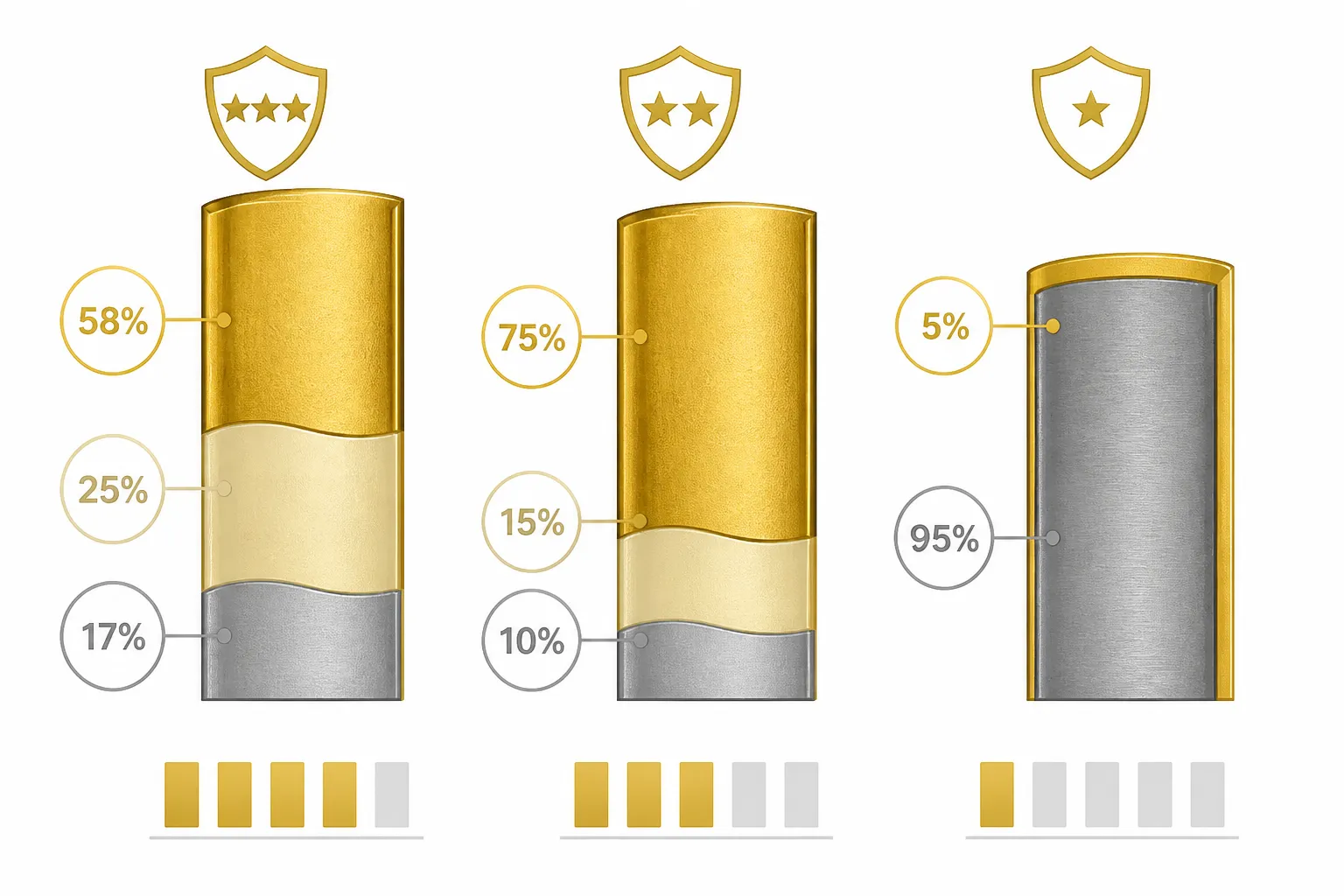
A: 14k gold means the alloy is 14 parts gold out of 24 — approximately 58.3% pure gold by weight, with the remainder typically copper, silver, or zinc for durability. In the U.S., the FTC's Jewelry Guides (16 CFR Part 23) require that any piece sold as "14k" must be within 0.5 karats of that mark — so no lower than 13.5 karats. Pieces must be stamped and, if that stamp is present, it must be accurate. This is a federal consumer protection rule, not just industry convention.
Q: How do I know if 14k gold stud earrings I'm importing are safe to sell in California?
A: California's Proposition 65 requires a warning label on products that expose consumers to chemicals listed by the state as causing cancer or reproductive harm — including lead and cadmium. For 14k gold jewelry, the gold alloy itself is generally not a Prop 65 concern, but findings, clasps, and any base-metal components (including backs/butterflies) may be. Request a Prop 65 compliance statement and a heavy metals test report (covering lead, cadmium) from your supplier. If the supplier cannot provide this, consider sourcing samples for independent testing at a CPSC-recognized lab.
Q: What's the difference between 14k solid gold, 14k gold-filled, and 14k gold vermeil for U.S. retail?
A: These are distinct product categories with different legal definitions under FTC guidance. Solid 14k gold is a gold alloy throughout the piece. Gold-filled must have a layer of at least 10k gold bonded to a base metal core, comprising at least 1/20th of the item's total weight by mass — it must be labeled "14/20 Gold Filled" or similar. Gold vermeil requires a sterling silver base with at least 2.5 microns of gold plating. Misrepresenting any of these categories to U.S. consumers is an FTC violation. Retail listings must be precise.
Q: What import duties apply to 14k gold stud earrings entering the U.S.?
A: Gold jewelry generally falls under HTS subheadings within Chapter 71. Standard duty rates have historically ranged from 6.5% to 7% of customs value for most gold jewelry from China — however, tariff schedules have been subject to significant adjustments due to Section 301 tariffs. Consult a licensed U.S. customs broker for the current applicable duty rate for your specific HTS code before placing a production order, as this materially affects your landed cost calculation.
Q: What MOQ should I expect when ordering custom 14k gold studs from a Chinese OEM supplier?
A: MOQ varies significantly by supplier and product complexity. For standard in-stock designs with custom packaging, some export-oriented OEM suppliers now offer MOQs as low as 12 pcs units per SKU — a range that has become viable for DTC brands. For fully custom designs (new tooling, unique stone setting, custom stamp), MOQs are typically higher to recover tooling costs. Always ask the supplier to separate the tooling/mold cost from the per-unit cost so you can model the economics accurately.
Q: How long does it take to receive a 14k gold stud earring order from a Chinese manufacturer?
A: Production lead times for in-stock styles with minor customization (branding, packaging) are typically shorter than for fully custom OEM. Air freight from China to a U.S. port typically adds a transit time on top of production. Total door-to-door timelines should be confirmed directly with your supplier and built into your inventory planning calendar, particularly for seasonal peaks. Request a written production timeline at order confirmation.
Q: Is it safe to buy 14k gold stud earrings from overseas for resale without additional U.S. testing?
A: Technically, a supplier's factory test certificates may suffice for general adult jewelry sold outside California. However, for retail platforms (Amazon Marketplace, Nordstrom, boutique retail programs) that require supplier compliance documentation, and for any jewelry marketed for children or sensitive-skin consumers, independent U.S. lab testing provides a necessary layer of protection. The cost of a standard RSL + heavy metals test is modest relative to the cost of a product recall or platform suspension.
Get Started in the United States
For U.S. buyers — whether you're a DTC brand founder building your first jewelry line, an importer expanding your catalog, or a retail buyer evaluating new suppliers — the key to successful 14k gold stud earrings procurement comes down to three things: verified material quality, documented compliance, and a supplier who communicates reliably in your time zone and language.
STRAND is a Hangzhou-based jewelry brand built specifically to bridge vetted Chinese workshops with overseas buyers in the U.S., EU, UK, and MENA. The STRAND model is designed around the procurement pain points that U.S. buyers consistently flag:
- Quality you can document: In-house QC before shipment, with third-party testing available on request — giving you the certificates your retail partners and compliance portals require.
- OEM with low MOQ: Custom hallmarking, branded packaging, and unique style development without the volume commitments that lock out emerging brands.
- Fast lead times: Production timelines calibrated to U.S. seasonal demand cycles, not generic factory schedules.
- English-first communication: Account management in English (plus Arabic and Spanish), with response windows designed to minimize the time-zone gap that frustrates U.S. buyers.
- Transparent trade terms: USD pricing, clear per-unit and tooling cost breakdowns, and payment structures standard in U.S.-China B2B trade.
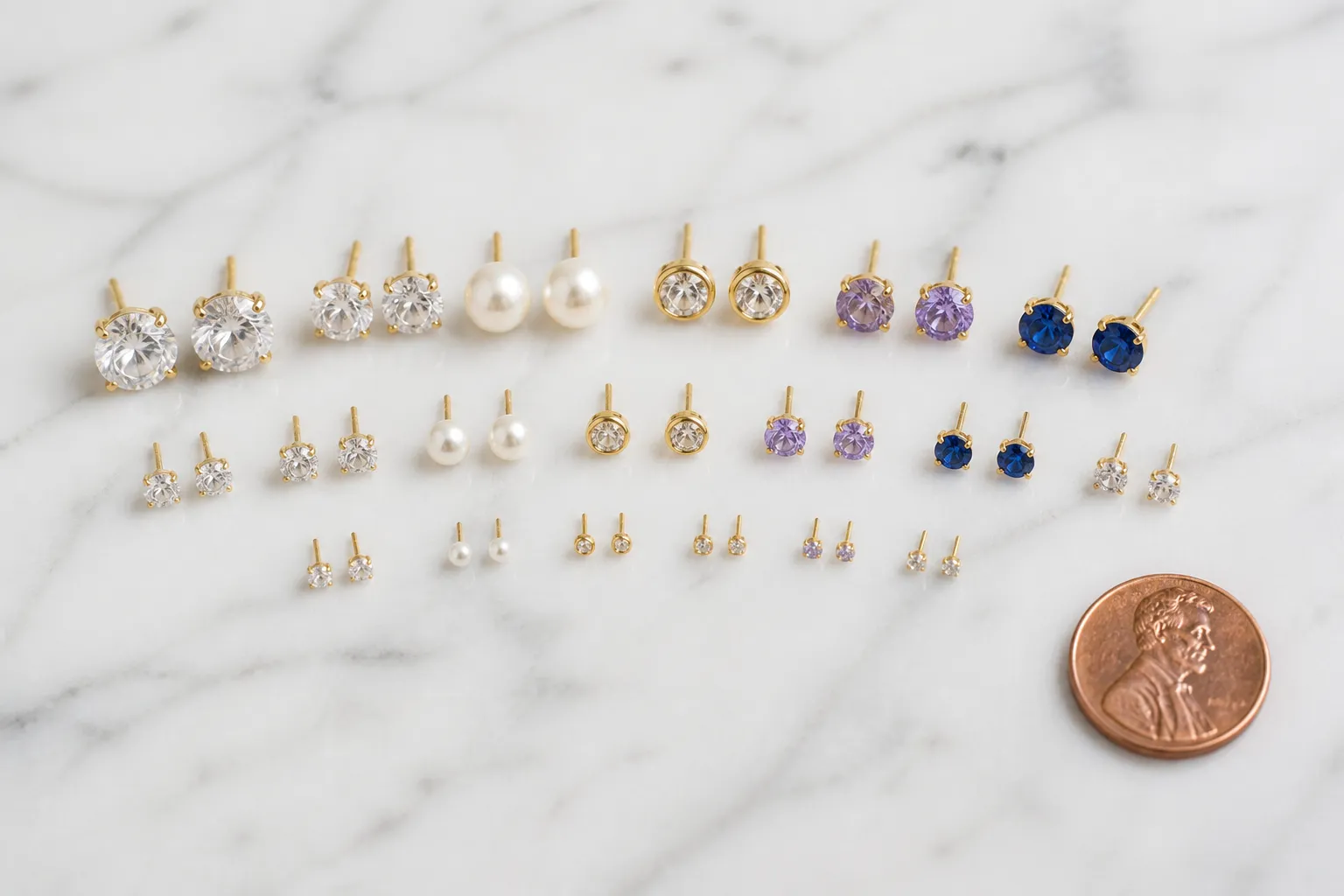
STRAND's stud earring catalog spans classic 14k gold ball and geometric styles, gradient crystal designs, two-tone glass bead compositions, rhinestone accent pieces, and vintage-inspired sets — with the full range available for OEM adaptation to your brand's aesthetic.
Ready to evaluate STRAND as your 14k gold stud earring supplier?
The next step is straightforward: submit an inquiry with your target style categories, estimated volume per SKU, and any compliance documentation requirements. The STRAND team will respond with MOQ tiers, per-unit pricing ranges, lead time estimates, and available sample options — everything you need to make a procurement decision.
Request a Quote & Get MOQ Pricing →
Whether you need 50 units of a custom branded stud or a full seasonal catalog run, STRAND's team is set up to evaluate your requirements and respond in business terms U.S. buyers recognize.
STRAND — Hangzhou-based. Globally compliant. Built for overseas buyers.