
Best Alternatives to Sterling Silver Earrings in 2026
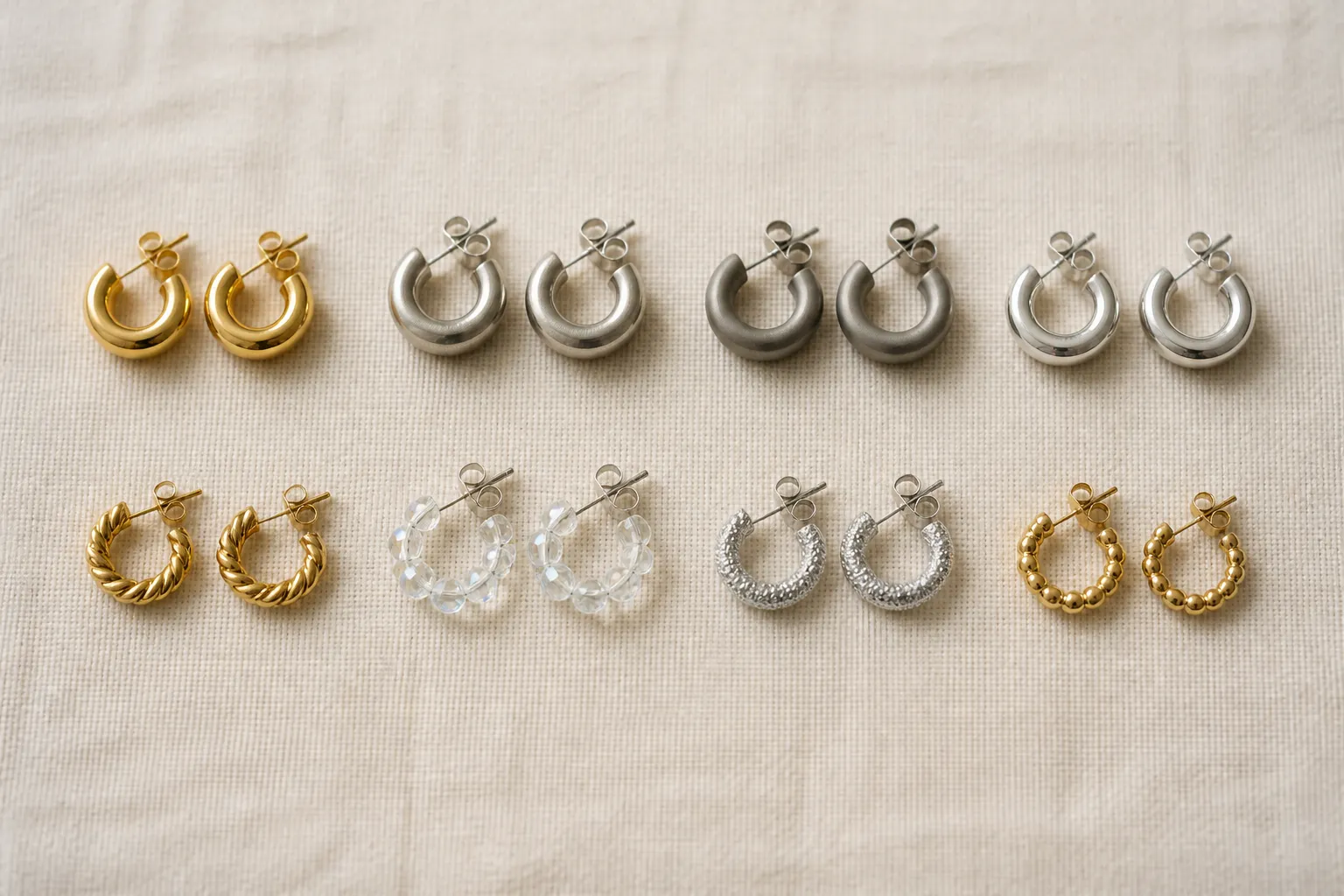
Best Alternatives to Sterling Silver Earrings in 2026
For DTC brands, importers, and procurement teams evaluating earring materials at scale
Sterling silver earrings have been a jewelry staple for decades. But if you're sourcing for a DTC store, building a wholesale catalog, or placing a large OEM order, you already know that "standard" rarely means "optimal." Price volatility, tarnishing complaints, hypoallergenic requirements, and MOQ realities are pushing buyers to rethink their default material choices. This guide covers every serious alternative — with honest trade-off analysis — so you can source smarter.
Why Look for Alternatives to Sterling Silver Earrings?
The silver price problem is real — and it compounds at scale. Silver trades as a commodity, which means the spot price built into your supplier's quote today may not reflect what you pay on your next reorder. For DTC brands and importers buying across multiple SKUs, this unpredictability creates margin risk that's hard to hedge at the product level. When silver prices spike, either your cost of goods rises or your supplier quietly downgrades alloy content — neither outcome is acceptable when you're building a brand around quality.
Tarnishing remains the top consumer complaint in the silver earring category. Sterling silver (925 silver) oxidizes on contact with moisture, sulfur compounds in the air, and skin chemistry. Customers expect their earrings to maintain appearance with minimal upkeep. When they don't, return rates climb and review scores fall. Sellers on platforms like Amazon and Etsy consistently flag "tarnishing after 2 weeks" as the leading driver of one-star reviews for sterling earrings — even on pieces from reputable suppliers. For importers and DTC operators, this post-sale liability is a recurring cost center.
Style diversity and OEM flexibility favor alternative materials. The vintage crystal drop, gradient glass bead, and rhinestone-set categories that are driving the highest sell-through in US, EU, and MENA markets right now are largely built on non-silver base materials. That's not a quality compromise — it's a deliberate material choice. Brass, stainless steel, and zinc alloy (zamak) accept plating, enamel, stone setting, and electroforming at production scales and lead times that pure silver simply cannot match. If you're building a trend-driven catalog with frequent drops, material flexibility is a genuine competitive advantage.
What to Look for in a Sterling Silver Earring Alternative
Before you request quotes, align your team on these evaluation dimensions:
- Tarnish & corrosion resistance — How will the piece perform after 6 months of wear? Does the plating spec come with a documented micron thickness?
- Hypoallergenic compliance — EU Nickel Directive (2004/96/EC), REACH, and CPSC requirements vary by market. Confirm what your target market mandates before committing to a base metal.
- Plating durability & re-plating options — A rhodium or gold plating that lasts 12+ months with normal wear is commercially viable; a 3-month plating is not, regardless of how good the piece looks on day one.
- OEM & customization flexibility — Can the supplier accommodate your logo, custom stone color, or packaging spec? What is the minimum order quantity for custom work?
- Price stability — Is the base material a traded commodity (silver, gold) or a manufactured input (stainless steel, zinc alloy) with more predictable pricing?
- Lead time at volume — Trend-driven categories need 30–45 day turnaround. Confirm your supplier's production capacity for your target SKU count.
- Certifications & compliance documentation — SGS, RoHS, REACH, and nickel-release test reports should be available before you place an order, not after.
Top 8 Alternatives to Sterling Silver Earrings
1. Gold-Filled Earrings
Best for: DTC brands positioning in the $30–$80 retail range who want a genuine precious-metal story without solid gold price points.
Pricing: Wholesale cost typically 1.5–2.5× sterling silver equivalent; retail $25–$120 per pair.
Key strengths vs sterling silver earrings:
- Contains a legally defined minimum gold content (5% or 1/20 by weight in the US), giving buyers a real quality narrative
- Dramatically more tarnish-resistant than sterling — properly made gold-filled pieces can last 10–30 years with normal care
- Warmer color tone appeals strongly in MENA and southern European markets
- Holds plating appearance far longer than base-metal alternatives
Limitations / trade-offs:
- Higher input cost than silver; margin pressure if retail positioning isn't premium
- US "gold-filled" standard differs from EU/UK definitions — international labeling requires care
- Less suitable for trend-driven fast fashion due to cost; better for evergreen catalog staples
How it compares to sterling silver earrings: Where sterling earrings derive their value story from purity (92.5% silver), gold-filled derives its story from the durability of a genuine gold layer bonded under heat and pressure. For buyers whose customers have complained about silver tarnishing, gold-filled is often the natural upgrade path — it solves the maintenance objection without requiring a jump to solid gold pricing. The trade-off is per-unit cost; gold-filled works best when your retail price supports a $35+ floor.
2. Gold Vermeil Earrings
Best for: Brands targeting the accessible-luxury segment who need a silver base with gold appearance — bridging sterling and gold-filled at a mid-tier cost.
Pricing: Wholesale typically 20–50% premium over sterling silver; retail $20–$80.
Key strengths vs sterling silver earrings:
- Sterling silver base qualifies for "925" hallmarking while gold plating delivers the visual warmth of gold
- US FTC requires minimum 2.5 micron gold plating for "vermeil" designation — thicker than standard gold-plated options
- Strong positioning for Instagram/DTC storytelling ("solid silver core, gold finish")
- Popular in both classic and trend styles; accommodates stone-setting and enamel details
Limitations / trade-offs:
- Plating will wear at contact points (earring posts, clip backs) over time — consumer education on care is required
- Silver base still carries commodity price exposure
- Not suitable for high-sweat or high-moisture wearers without explicit care guidance
How it compares to sterling silver earrings: Vermeil gives you the 925 silver substrate your supply chain already knows, layered with a durable gold finish that commands a higher retail price. If your sterling earrings are already performing but you want a premium line extension, vermeil is the cleanest pivot — same sourcing workflow, better margin per unit, and a narrative that resonates with gift buyers.
3. Stainless Steel Earrings
Best for: High-volume importers and wholesale buyers prioritizing durability, hypoallergenic compliance, and price stability across large SKU counts.
Pricing: Among the lowest cost-per-unit options; wholesale often 30–60% less than comparable sterling silver.
Key strengths vs sterling silver earrings:
- Surgical-grade 316L stainless steel is inherently nickel-safe and passes EU Nickel Directive requirements without additional treatment
- Will not tarnish, rust, or corrode under normal wearing conditions — no consumer maintenance required
- Accepts IP (ion plating) in gold, rose gold, and black finishes with excellent durability (typically 1–3 microns, far more wear-resistant than electroplating)
- Highly stable input pricing — no commodity exposure
Limitations / trade-offs:
- "Stainless steel" carries a perception gap vs. silver/gold in premium retail channels — harder to position above $40 retail without strong brand equity
- Heavier than silver for large statement pieces; less suitable for extended lightweight drop earrings
- Limited enamel and stone-setting compatibility vs. brass or zinc alloy base metals
How it compares to sterling silver earrings: Stainless steel is the workhorse alternative. It solves tarnishing, solves the allergy concern, solves pricing volatility, and produces a finished piece that holds its appearance longer than most silver options. The trade-off is purely perceptual: customers buying on material prestige expect silver or gold language. For brands competing on design and durability rather than material heritage, stainless steel often outperforms silver on total landed cost and return rate metrics.
4. Titanium Earrings
Best for: Specialty retailers serving customers with documented metal allergies, sensitive skin, or post-piercing healing needs.
Pricing: Mid-to-premium wholesale; typically 10–30% above stainless steel equivalents depending on grade.
Key strengths vs sterling silver earrings:
- Implant-grade titanium (Grade 23 / Ti-6Al-4V ELI) is the gold standard for hypoallergenic jewelry — exceeds EU Nickel Directive requirements
- Extremely lightweight relative to metal volume; ideal for large drop earrings
- Naturally biocompatible; used in medical implants — zero alloy migration risk
- Available in anodized color finishes (blue, purple, gold) without plating
Limitations / trade-offs:
- Titanium is difficult to work with at scale — machining costs are higher than brass or zinc alloy
- Limited stone-setting and enamel compatibility in standard production workflows
- Color anodizing doesn't achieve the warm gold or bright silver tones buyers expect from fashion jewelry
How it compares to sterling silver earrings: Titanium is a niche play, not a volume replacement for silver. If your customer base includes people with nickel sensitivity, post-surgical earring needs, or dermatologically sensitive skin, titanium solves a problem that sterling silver creates. For general fashion SKUs, the production cost and style limitations don't support broad catalog adoption.
5. Rhodium-Plated Brass Earrings
Best for: Fashion-forward brands and trend buyers who want the bright white look of silver without silver's tarnishing or commodity pricing.
Pricing: Generally 20–40% less than sterling silver at wholesale; highly scalable for OEM.
Key strengths vs sterling silver earrings:
- Rhodium is one of the most reflective metals available — the finish is visually brighter than polished silver
- Brass base accepts intricate casting, filigree, and stone-setting at significantly lower tooling cost than silver
- Rhodium coating provides excellent tarnish and scratch resistance
- Ideal base for rhinestone, crystal, and glass bead earring designs popular in the US and MENA markets
Limitations / trade-offs:
- "Brass" base can trigger nickel sensitivity if alloy composition is not controlled — always request nickel-release test reports
- Rhodium plating thickness must be specified (0.05–0.5 microns typical) — thin platings wear within months at contact points
- Cannot be marketed as silver or precious metal content
How it compares to sterling silver earrings: For the visual aesthetic of silver without the maintenance liability, rhodium-plated brass is arguably the strongest alternative for fashion-forward DTC catalogs. The brightness is indistinguishable to most consumers, the cost is lower, and the style flexibility — especially for crystal drop and rhinestone designs — is significantly greater. The trade-off is the "brass" label, which some premium buyers perceive as a downgrade from 925 silver even when the finished piece performs better.
6. Crystal & Glass Bead Earrings
Best for: Trend-driven DTC brands, boutique buyers, and importers building Instagram-optimized catalogs in the vintage, gradient, and artisan aesthetic categories.
Pricing: Highly variable; base cost often lower than silver but depends heavily on glass/crystal quality and hardware spec.
Key strengths vs sterling silver earrings:
- Gradient, aurora, and color-shifting glass beads create visual effects impossible to replicate in metal alone
- Hypoallergenic when hardware is stainless steel or titanium — the bead itself presents no allergy risk
- Exceptional sell-through in the US, EU, and MENA gift and occasionwear segments
- OEM customization — bead color, shape, finish, and hardware — is highly accessible with experienced suppliers
Limitations / trade-offs:
- Glass beads are fragile vs. metal; requires careful packaging and shipping specs to control breakage in transit
- Not positioned as precious or semi-precious — requires different retail copy and value narrative
- Style has trend exposure; what's selling strongly in 2026 may require catalog refresh by 2027
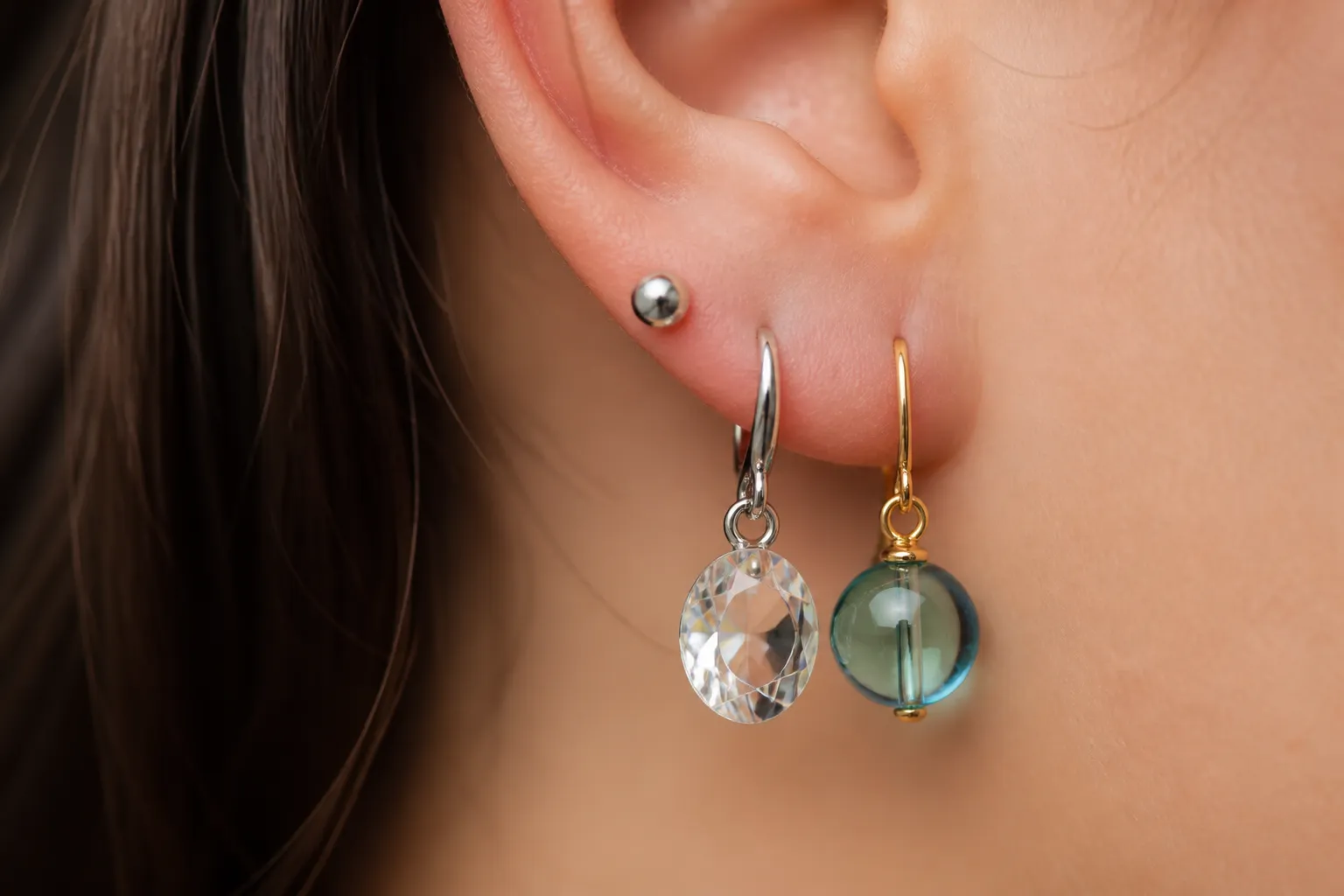
How it compares to sterling silver earrings: Crystal and glass bead earrings compete in a different positioning lane than sterling silver — they win on visual drama, color play, and trend relevance rather than material prestige. For buyers building catalogs that capture impulse purchase and gift segments, gradient crystal drops and two-tone glass bead styles consistently outperform plain silver on units-per-SKU. Brands like STRAND have built their OEM program around exactly this category, offering vetted crystal and glass bead earring production with multilingual procurement support for buyers in the US, EU, UK, and MENA markets.
7. Zinc Alloy (Zamak) Fashion Earrings
Best for: High-volume, trend-driven buyers with tight retail price points ($5–$25) who prioritize design versatility and short lead times over material longevity.
Pricing: Lowest cost-per-unit in the category; enables aggressive retail price points.
Key strengths vs sterling silver earrings:
- Excellent die-casting capability — complex shapes, fine details, and intricate designs at low tooling cost
- Accepts electroplating (gold, silver, rose gold, gunmetal) and enamel filling reliably
- Very short production lead times; ideal for fast-fashion replenishment models
- Widely available from vetted Chinese workshops with established OEM capability
Limitations / trade-offs:
- Lower plating adhesion durability vs. brass or stainless — suitable for seasonal, not evergreen, catalog positions
- Zinc alloy composition must be controlled for lead and cadmium content — CPSC and REACH compliance documentation is mandatory, not optional
- Not appropriate for sensitive skin without hypoallergenic hardware on the post/back
How it compares to sterling silver earrings: Zamak is the volume material of the fast-fashion jewelry industry. It is not a prestige alternative to sterling — it's a different product entirely, serving a different price point and lifecycle expectation. Buyers who source zamak successfully treat it as a seasonal SKU, not a permanent catalog item, and price it accordingly. For importers building $10–$18 retail earring lines for market stalls, pop-up shops, or promotional GWP (gift with purchase), zamak delivers design richness that sterling at the same price point simply cannot.
8. Solid 14K / 18K Gold Earrings
Best for: Fine jewelry retailers, boutiques, and DTC brands serving the premium and bridal segments where material authenticity commands a price premium.
Pricing: Significantly higher than sterling silver — expect wholesale cost multiples of 5–20× depending on gold content, weight, and stone setting.
Key strengths vs sterling silver earrings:
- Genuine precious metal content supports hallmarking, certification, and collector value narrative
- Does not tarnish, oxidize, or require coating maintenance
- Strong resale and lifetime value story resonates with bridal and anniversary buyers
- 18K gold is hypoallergenic at all standard alloy compositions
Limitations / trade-offs:
- Gold commodity pricing means significant per-unit cost and margin volatility at scale
- MOQ for OEM custom solid gold work is typically higher and lead times longer than base-metal options
- Not scalable for trend-driven or promotional catalog segments
How it compares to sterling silver earrings: Solid gold is the prestige upgrade path from sterling, not a cost-reduction strategy. For brands where the customer journey includes a material upgrade narrative — "we started with sterling, we moved to gold" — solid gold earrings are a logical top-of-catalog anchor. For volume importers and trend buyers, the economics don't support solid gold outside of hero SKUs.
Side-by-Side Comparison Table
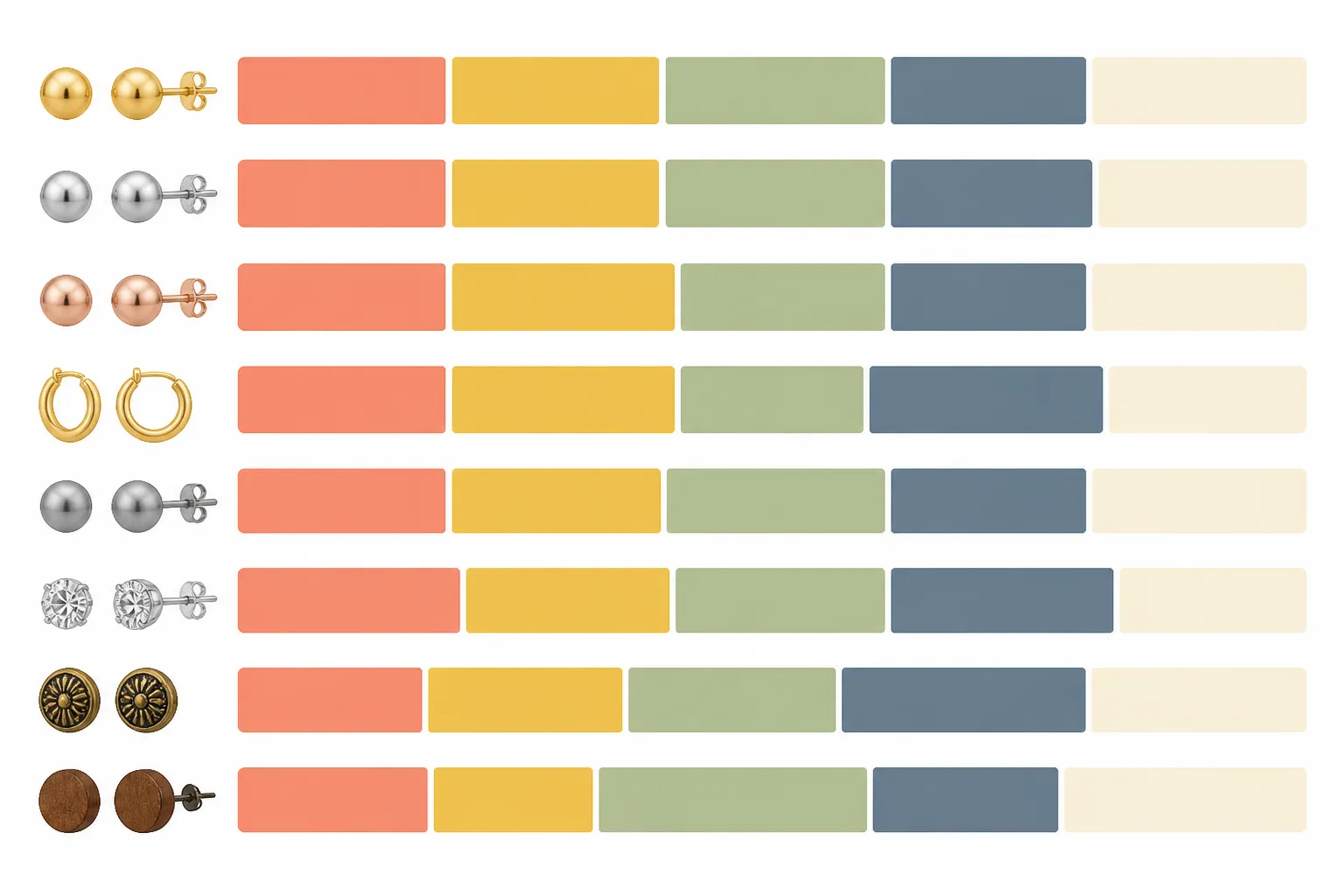
| Dimension | Sterling Silver | Gold-Filled | Stainless Steel | Rhodium-Plated Brass | Crystal/Glass Bead | Zinc Alloy (Zamak) |
|---|---|---|---|---|---|---|
| Tarnish Resistance | Medium | High | Very High | High | N/A (bead) | Low–Medium |
| Hypoallergenic | Medium (nickel risk) | Medium | High (316L) | Medium (alloy-dependent) | High (hardware-dependent) | Low–Medium |
| Price Stability | Low (commodity) | Low (commodity) | High | High | High | High |
| OEM Flexibility | Medium | Medium | High | Very High | Very High | Very High |
| Retail Price Floor | $15–$25 | $25–$50 | $8–$20 | $10–$35 | $10–$40 | $5–$18 |
| Best Market Fit | Classic, gifting | Premium DTC | Hypoallergenic, volume | Fashion, trend, rhinestone | Trend, DTC, MENA | Fast fashion, promotional |
How to Pick the Right Alternative
If your primary pain point is tarnishing complaints: Move to stainless steel (316L) or gold-filled. Both solve the oxidation problem at the product level and reduce post-sale service costs.
If you're building a trend-driven DTC catalog with frequent drops: Rhodium-plated brass or crystal/glass bead earrings give you the design flexibility and lead time your model requires. Sterling silver's material cost and supply chain lead times often work against fast-fashion cadences.
If you're sourcing for MENA markets: Gold-tone finishes significantly outperform silver-tone across the Gulf, Levant, and North Africa. Rhodium-plated brass with gold IP or gold vermeil earrings align with regional aesthetic preferences. Crystal and glass bead styles with warm-tone hardware are also strong performers.
If hypoallergenic compliance is a requirement: Define which market standard applies first (EU Nickel Directive vs. US CPSC vs. UK standards). For EU export, request nickel-release test reports for every base metal option. Stainless steel 316L and titanium are your safest defaults; confirm alloy composition in writing before placing production orders.
If you're managing tight retail price points ($10–$25 retail): Stainless steel and zinc alloy are your realistic options. Sterling silver at this price point either compresses margin to unsustainable levels or signals to buyers that the silver content is minimal.
If you're evaluating OEM with custom branding: Brass-base earrings (rhodium-plated or gold-IP) offer the widest tooling compatibility, lowest minimum order quantities for custom designs, and the fastest lead times. Suppliers like STRAND with in-house QC and established OEM workflows for overseas buyers can accommodate custom stone colors, hardware finishes, and packaging within a single production run.
Conclusion: Top Picks for Different Buyer Profiles
For the DTC brand building a premium evergreen catalog: Gold-filled or gold vermeil earrings solve the tarnishing liability while maintaining a genuine precious-metal narrative. Accept the higher per-unit cost as a brand investment.
For the volume importer sourcing across 50+ SKUs: Stainless steel (316L) and rhodium-plated brass give you the broadest design range, most stable pricing, and cleanest compliance posture. Establish clear plating thickness specs in your purchase orders.
For the trend buyer dropping new collections monthly: Crystal and glass bead earrings — vintage crystal drops, gradient bead styles, two-tone rhinestone designs — are the highest-velocity category in this cycle. Suppliers with OEM flexibility, low MOQ, and multilingual procurement support (English, Arabic, Spanish) are particularly valuable for multi-market sourcing operations.
For the boutique or specialty retailer serving sensitive-skin customers: Titanium posts with any of the above decorative elements is the cleanest solution. Specify hardware separately from the decorative component in your OEM brief.
Sterling silver earrings remain a legitimate catalog choice when the material story matters to your customer and your price point supports the commodity cost. But for buyers who've discovered that silver's pain points — tarnishing, price volatility, allergy risk, and style constraints — are creating real business friction, the alternatives in this guide offer a more controlled path to margin, customer satisfaction, and scale.
Ready to Source Earring Alternatives at Scale?
If you're evaluating materials, exploring OEM customization, or building a new earring line for the US, EU, UK, or MENA market, STRAND works directly with vetted Hangzhou-based workshops to connect overseas buyers with production capacity and in-house QC — without the opacity of traditional sourcing chains.
What to prepare before reaching out:
- Target retail price point and estimated order volume
- Market(s) and compliance requirements (EU Nickel Directive, CPSC, REACH)
- Preferred materials and finish (stainless steel, rhodium brass, crystal, etc.)
- Customization requirements: logo, stone color, hardware finish, packaging
- Lead time target and whether sampling is required before full production
STRAND's multilingual team (English, Arabic, Spanish) can provide MOQ guidance, production lead times, and sample pricing within your first inquiry.
Request a Quote or Get MOQ & Pricing → strandjewelry.com
Last updated: June 2026. Material pricing tiers and compliance standards may change; confirm current specifications with your supplier before placing production orders.