
Silver Earrings Sourcing Guide for DTC & OEM Cross-Border Buyers
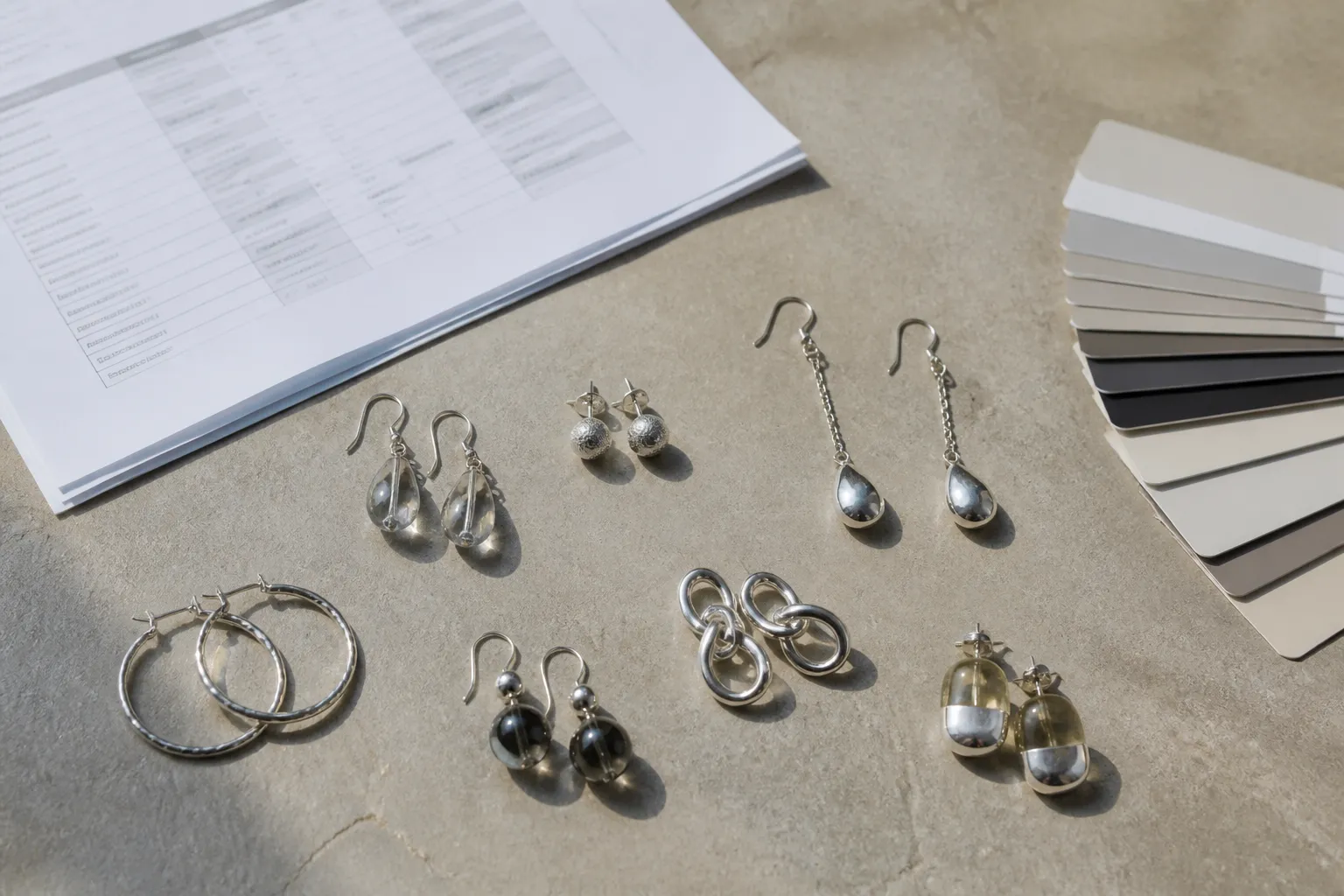
Silver Earrings Sourcing Guide for DTC & OEM Cross-Border Buyers
The Cross-Border Fashion Jewelry Reality
The global fashion jewelry market is not a monolith — it is a mosaic of micro-seasons, channel-specific demand signals, and procurement pipelines that span continents. For buyers sourcing silver earrings across the US, EU, UK, and MENA, the reality is one of perpetual tension: consumers in Riyadh want ornate drop earrings with geometric Arabic-inspired patterns while a Shopify DTC brand in Los Angeles is chasing the exact same "minimalist sculptural" trend they saw go viral on TikTok three weeks ago. The lead time between a trend emerging and a buyer needing finished inventory in-warehouse is often fewer than 60 days — a window most Western manufacturers simply cannot meet.
This compression of the trend-to-shelf cycle has permanently restructured how serious buyers approach sourcing. The most competitive DTC operators and importers no longer treat silver earrings as a commodity SKU they can reorder from a domestic wholesaler. Instead, they operate hybrid supply chains rooted in direct relationships with Chinese production hubs — specifically Yiwu, Guangzhou, and Hangzhou — where skilled workshops can translate a reference image into a production-ready OEM sample in days rather than months. The question for buyers is no longer whether to source from China, but how to do it reliably, repeatably, and with the kind of quality control that protects their brand reputation in demanding Western and Gulf markets.
What makes this particularly challenging is the operational complexity layered beneath the product itself. Customs classifications for silver-plated versus sterling silver jewelry differ by country. REACH compliance governs nickel and lead content for the EU. CPSC rules affect children's jewelry sold in the US. A Hangzhou workshop that excels at gradient crystal drop earrings may or may not have tested its platings to EN 1811 standards. And the importer absorbs the compliance risk on the receiving end. The sourcing decision, then, is never just about the earring — it is about the entire ecosystem of trust, documentation, and communication that surrounds it.
Why Generic Solutions Fall Short for Cross-Border Fashion Jewelry (DTC + OEM)
Most B2B sourcing platforms and generic jewelry wholesalers are built for domestic retail replenishment — high-volume, narrow-SKU, predictable seasonality. Cross-border fashion jewelry doesn't work that way. A DTC store owner running a curated earrings collection might carry 40–80 active SKUs simultaneously, each with a different colorway, plating finish, or stone type. An importer supplying multi-door boutiques across the MENA region needs consolidated shipments with Arabic-language product cards. Neither profile is served well by a platform optimized for bulk commodity reorders.
The gaps that generic sourcing approaches expose are specific and expensive. First, there is the communication barrier: most Chinese workshops operate in Mandarin, and even when English is offered, the precision required for jewelry OEM — communicating earring post gauge, plating thickness in microns, rhodium versus gold-tone finish, closure type — is easily lost in translation. A rhinestone stud that arrives with a butterfly back when the buyer specified a screw back is not a minor inconvenience; it is a returns problem, a customer trust problem, and a reorder problem.
Second, there is the MOQ mismatch. Large trading companies set minimum order quantities designed for import distributors, not DTC operators testing new designs. A DTC buyer who wants to trial 50 units of a vintage crystal drop earring before scaling to 500 cannot do so with most factory-direct programs. Third, there is quality verification opacity: without in-house QC at the origin point, buyers are dependent on factory self-reporting for things like plating durability, stone adhesion, and closure integrity — properties that only reveal themselves after customers have received and worn the product.
These are not edge-case concerns. They are the primary reasons that cross-border fashion jewelry sourcing has historically been dominated by buyers with boots-on-the-ground sourcing agents or expensive relationships with trading companies. The structural opportunity — and the STRAND value proposition — lies in eliminating those intermediaries without eliminating the expertise they provided.
Core Use Cases: Silver Earrings in Cross-Border Fashion Jewelry Sourcing
1. OEM Product Development: From Trend Reference to Finished Silver Earring
The problem: A DTC brand sees a two-tone glass bead drop earring trending on Instagram. Their product development cycle requires moving from visual reference to production-ready sample to first delivery within 45 days. Their previous supplier required 90 days minimum and a 500-unit MOQ.
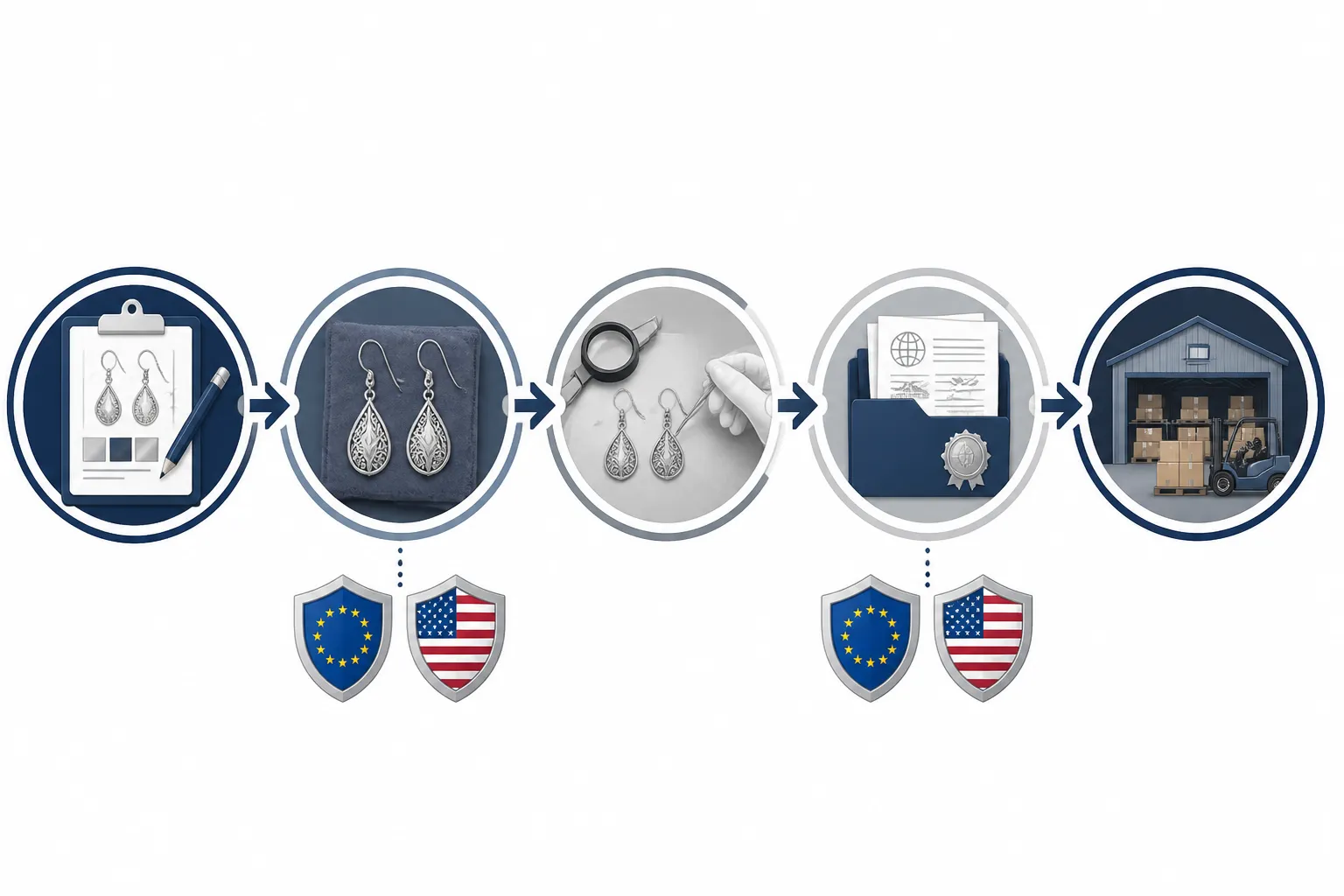
How sourcing from a vetted Hangzhou workshop addresses it: Hangzhou-based operations like STRAND have cultivated direct workshop relationships that compress the sample cycle dramatically. A buyer submits a reference image, specifies dimensions, closure type (lever-back, post, or hook), plating finish (silver-tone rhodium, antique silver, two-tone), and stone type. A physical sample is produced and shipped for approval. If the buyer approves with minor revisions, production begins against a low MOQ that makes initial-run economics work for a DTC operator.
What success looks like: A completed OEM cycle — from reference to approved sample to first production shipment — executed within the buyer's trend window. Success metrics include: sample approval rate on first revision, on-time delivery rate against agreed lead time, and post-sale return rate attributable to product quality defects.
Vignette: A UK-based earrings brand submitted a Pinterest board of 12 vintage crystal drop earring references on a Monday; by Thursday they had confirmed pricing and specs, and samples shipped the following week — enabling a launch that captured seasonal demand before competitor reorders arrived.
2. Inventory Diversification: Expanding from Single-Style to Multi-SKU Silver Earring Collections
The problem: An importer supplying boutique chains across the US has built their business on a single stud earring program. Retail buyers are now demanding a more complete earrings assortment — they want drop, stud, and set options in coordinated colorways. Building that assortment from scratch with multiple suppliers creates fragmented quality control and complicated logistics.
How a consolidated OEM supplier addresses it: Working with a supplier capable of producing across earring formats — stud earrings, drop earrings, and necklace + earring sets — from a single sourcing relationship allows the importer to consolidate quality standards, shipping documentation, and payment terms. Coordinated colorways across SKUs (matching gradient crystal finishes across studs and drops, for example) require production coordination that only happens reliably under a single roof or tightly integrated workshop network.
What success looks like: The importer presents retail buyers with a coherent assortment story — vintage silver, two-tone glass bead, rhinestone — with consistent plating quality across all formats. Success is measured in assortment acceptance rate at the retail buyer level, reduction in per-unit logistics cost through consolidated shipments, and reduction in QC incidents from multi-supplier variability.
Vignette: A Houston-based importer consolidated three separate Chinese suppliers into a single Hangzhou relationship, cutting their per-shipment documentation burden by 60% and eliminating the colorway-matching inconsistencies that had generated buyer complaints the previous season.
3. Multilingual Procurement: Serving MENA Buyers with Arabic-Language Support
The problem: A Dubai-based jewelry distributor wants to source silver earrings for the Gulf retail market — ornate drop styles and rhinestone designs with broad gift-market appeal. Their procurement team communicates primarily in Arabic. Previous Chinese supplier relationships have broken down repeatedly over specification miscommunications that neither party could resolve without a bilingual intermediary, which added cost and delay.
How multilingual supplier service addresses it: STRAND's Arabic-language procurement support eliminates the intermediary layer. Buyers in Saudi Arabia, UAE, Egypt, and across the MENA region can submit RFQs, review samples, negotiate terms, and manage reorders in Arabic. Product specifications — critical for jewelry, where a millimeter-level error in earring post length or a misunderstood closure type creates an unusable SKU — are confirmed in the buyer's primary language.
What success looks like: Zero specification errors attributable to language miscommunication. MENA buyers measure success in reorder rates (a sign that first-order quality met expectations), speed of issue resolution when problems arise, and their ability to present Chinese-made product to Gulf retail buyers with confidence in quality documentation.
Vignette: A Riyadh-based accessories distributor placed their first OEM order for rhinestone drop earrings entirely in Arabic, receiving spec confirmations, a proforma invoice, and QC photo documentation in Arabic — without a single email requiring translation.
4. Quality Assurance Verification: Meeting EU REACH and US CPSC Standards for Silver Earrings
The problem: A German DTC earrings brand importing silver jewelry from Asia has been burned once by a customs detention triggered by nickel content exceeding EU EN 1811 limits. They cannot risk another incident. Their current supplier provides certificates of conformity, but the brand's QC manager suspects these are self-issued rather than third-party verified.
How in-house origin QC addresses it: A supplier with genuine in-house quality control — not outsourced, not self-reported by the workshop — provides a meaningful checkpoint between production and export. Before jewelry ships, QC inspectors verify plating adhesion, closure function, stone security, and dimensional tolerances. For compliance-sensitive markets, this is the tier where test reports from accredited labs (SGS, Intertek, BV) should be requested and reviewed against the actual shipment lot.
What success looks like: Zero customs detentions for nickel or lead content violations. Zero customer returns attributable to plating failure within the warranty window. A documented QC trail that the brand's compliance team can present to retail partners or platform marketplace audit requests.
Vignette: An Amsterdam-based DTC brand required pre-shipment photo documentation of 15 QC checkpoints per SKU; their Hangzhou supplier provided a standardized report for every order, enabling the brand to pass a platform marketplace supplier audit without requesting a single additional document.
5. Seasonal Scale-Up: Managing Q4 and Gifting Season Demand Surges
The problem: Fashion earrings — particularly rhinestone, gradient crystal, and vintage-style silver earrings — are intensely seasonal. A DTC brand that sells 200 units of a drop earring in September may need 2,000 in November for Black Friday and the holiday gifting window. Most suppliers require orders to be placed 90+ days in advance, but the brand doesn't know their Q4 forecast that accurately until October.
How fast lead time and production capacity address it: A supplier with strong workshop relationships and a flexible production calendar can accommodate late-season scale-ups that rigid factory programs cannot. The key enablers are: established tooling for existing SKUs (no new mold costs), pre-negotiated production slots, and a QC infrastructure that can handle accelerated timelines without cutting corners on inspection.
What success looks like: Inventory available in-warehouse before peak demand dates. No stockout events during the gift-giving window. Production quality consistent with lower-volume baseline orders — no evidence that rush production compromised plating or stone adhesion standards.
Vignette: A Shopify DTC brand placed a 3x scale-up order for vintage silver drop earrings in mid-October and received production confirmation for a pre-Black Friday delivery date — a timeline their previous supplier had refused to guarantee.
6. Private Label + Custom OEM: Building a Brand Identity Around Silver Earring Collections
The problem: A mid-size US accessories brand wants to stop reselling generic jewelry and build an owned earrings line with proprietary designs, custom packaging, and brand-exclusive colorways. They have design files but no manufacturing relationships in China, and they are wary of the IP and quality risks of approaching workshops cold.
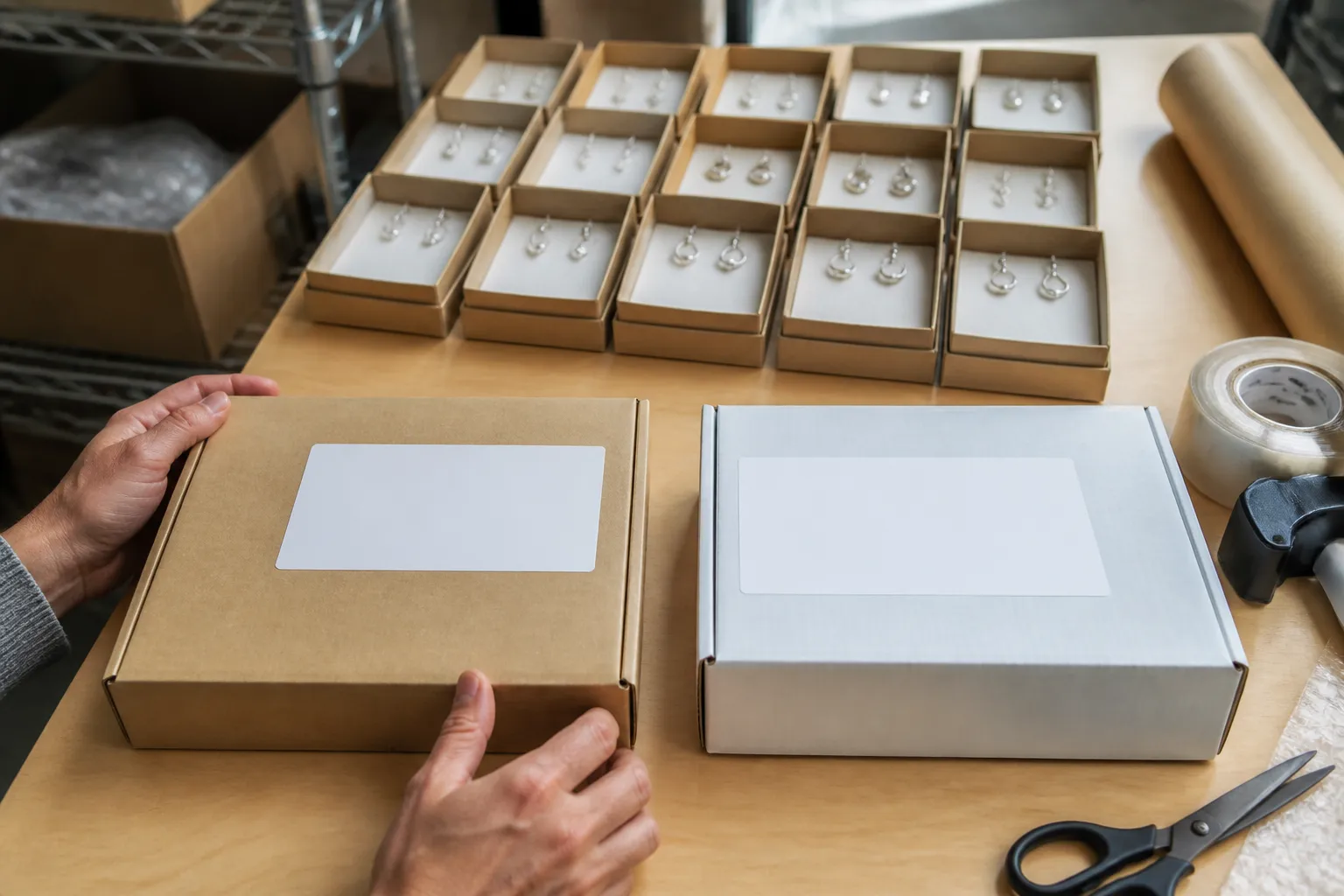
How vetted OEM with transparent trade terms addresses it: An OEM relationship through a verified Hangzhou intermediary provides design-to-production support without requiring the brand to navigate Chinese factory sourcing independently. The brand submits design files or works with the supplier's design team to develop custom earring silhouettes. Custom packaging — branded earring cards, gift boxes, tissue paper — is coordinated in the same production cycle. Transparent trade terms clarify IP ownership from the first purchase order.
What success looks like: A completed private label launch with proprietary earring designs that cannot be found in a competitor's catalog. Success metrics include design exclusivity period, packaging quality acceptance rate, and the brand's ability to command premium retail pricing on the basis of perceived design distinctiveness.
Vignette: A Los Angeles accessories brand launched a 12-SKU private label earrings line — studs, drops, and matching sets in a signature gradient crystal colorway — with custom earring cards printed in English and Spanish, serving both their US Shopify store and a Spanish-language wholesale account simultaneously.
Considerations Specific to Cross-Border Fashion Jewelry (DTC & OEM)
Regulatory and Compliance
Silver earrings sold across the US, EU, UK, and MENA markets face distinct and non-harmonized regulatory requirements. EU buyers must comply with REACH Regulation (EC) No 1907/2006, specifically Annex XVII restrictions on nickel release — EN 1811 sets the test standard for items in direct contact with skin. UK buyers post-Brexit follow equivalent UK REACH regulations. US buyers importing jewelry must consider CPSC lead content rules (particularly for items that could be marketed to children) and California Proposition 65 requirements for lead and cadmium in jewelry. MENA markets, particularly GCC countries, may require specific conformity marking or Gulf Standardization Organization (GSO) documentation for certain product categories.
Buyers should always request: test reports from an accredited third-party lab (SGS, Intertek, Bureau Veritas) specific to the destination market, issued against the production lot being shipped — not historical tests on similar products.
Integration with Industry-Standard Sourcing Tools
Cross-border jewelry buyers increasingly manage procurement through tools like Alibaba Trade Assurance, Global Sources, Faire (for boutique wholesale), or proprietary ERP systems with supplier portals. A supplier capable of issuing purchase orders in internationally standard formats (commercial invoice, packing list, certificate of origin for preferential duty treatment under relevant FTAs) reduces friction at the customs clearance stage significantly. For DTC operators, integration between sourcing lead times and Shopify inventory management or Amazon FBA inbound shipping windows is operationally critical during seasonal scale-ups.
Data Sensitivity and IP Protection
OEM buyers sharing proprietary design files, brand assets, or customer demand data with Chinese workshops should establish clear confidentiality expectations. A reputable Hangzhou-based supplier will confirm IP non-disclosure terms in the purchase agreement. Design exclusivity — the workshop's commitment not to produce the same silhouette for other buyers — is a separate negotiation point that should be confirmed explicitly before production begins.
Scale and Seasonality
Fashion earrings are among the most seasonally volatile SKUs in the accessories category. Valentine's Day, Eid gifting, Mother's Day, and the November–December holiday window each create demand spikes of 3–10x baseline. Buyers should discuss production capacity, available production calendar windows, and rush-order premium costs with their supplier before peak season, not during it. Understanding a workshop's annual capacity ceiling is as important as knowing their MOQ floor.
Implementation Roadmap for Cross-Border Fashion Jewelry Teams
Phase 1 — Pilot (Weeks 1–6)
- Define your initial SKU scope: select 2–4 earring styles (e.g., one stud, one drop, one set) to test across sourcing, QC, and delivery.
- Submit detailed OEM briefs — include dimension specs, closure type, plating finish, stone type, and destination market compliance requirement (EU REACH, US CPSC, or GCC).
- Request samples and review against your internal quality standard before approving for production.
- Place a pilot production order at
12 pcsand document the full lead time from PO to warehouse arrival. - Conduct post-delivery QC audit: photograph and inspect minimum 10% of units per SKU.
Phase 2 — Pilot Orders & Range Expansion (Months 2–4)
- Expand SKU count to your full planned assortment — integrate gradient crystal, rhinestone, and vintage silver styles as applicable to your market.
- Establish reorder triggers based on sell-through data; communicate forecast to supplier no fewer than
[your agreed lead time]weeks in advance of need date. - Set up consolidated shipment schedules to optimize freight cost per unit.
- Build a compliance documentation library: store test reports, certificates of origin, and QC photo records by shipment lot.
- Assign a procurement point-of-contact who manages the multilingual supplier relationship.
Phase 3 — Supply-Chain Integration (Months 5–12)
- Integrate supplier lead times into your seasonal buying calendar and DTC inventory planning system.
- Negotiate volume-based pricing tiers as annual order volume grows.
- Explore exclusive design development for proprietary SKUs that differentiate your catalog.
- Establish a formal supplier scorecard: tracking on-time delivery rate, first-pass QC acceptance rate, and issue resolution speed.
- Review compliance documentation annually as destination-market regulations evolve.
ROI and Business Outcomes for Cross-Border Fashion Jewelry Teams
The financial case for a structured, direct-to-workshop silver earrings sourcing program rests on several compounding metrics that matter specifically in this vertical:
Landed Cost Per Unit Reduction: Eliminating a domestic wholesaler or trading company intermediary typically reduces per-unit cost by 20–40% on comparable quality. For a DTC brand selling earrings at $28–$48 retail, a $3–5 improvement in landed COGS has a material impact on contribution margin.
Return Rate Reduction: Quality-related returns in fashion earrings — plating failure, loose stones, defective closures — are a significant margin drain. In-house origin QC before shipment reduces the probability that defective units reach customers. A reduction from a 4% return rate to a 1.5% return rate on a 5,000-unit earring line represents a meaningful recovery in net revenue.
Trend-Cycle Win Rate: For DTC operators, being first to market with a trending earring style is a revenue multiplier. A sourcing partner with a 25–35 day sample-to-production capability versus a 60–90 day alternative translates directly into additional full-price sell-through weeks before the trend saturates.
Supplier Consolidation Savings: Managing three separate supplier relationships for studs, drops, and sets requires three times the procurement overhead — three QC audits, three sets of shipping documentation, three payment reconciliations. Consolidating into a single OEM partner with multi-format capability reduces procurement labor cost and compliance documentation burden.
Reorder Reliability: Consistent plating standards and stone sourcing from a stable workshop relationship mean that a reorder of a best-selling silver earring SKU arrives looking identical to the original — protecting the brand's visual consistency and reducing customer complaints about "different batch" quality variance.
Conclusion: Next Steps for Cross-Border Jewelry Buyers
Silver earrings remain one of the highest-velocity, highest-margin SKU categories in cross-border fashion jewelry — and the sourcing decisions you make today determine whether you capture that margin or cede it to competitors who have already built direct workshop relationships.
The evaluation criteria that matter before reaching out to a supplier are clear: What is the MOQ for OEM sampling versus production? What are the lead times across each phase — sample, approval, production, shipping? What compliance documentation is provided as standard, and can the supplier support EU REACH and US CPSC market requirements simultaneously? What does the in-house QC process look like, and how is it documented? Is multilingual procurement support available for your team's working language?
These are procurement questions, not catalog questions — and they deserve direct answers from a supplier who understands the cross-border DTC and import context, not boilerplate responses from a trading platform.
STRAND is a Hangzhou-based cross-border jewelry brand built specifically for buyers in the US, EU, UK, and MENA who need vetted workshop access, in-house quality control, low MOQ OEM capability, and multilingual procurement support in English, Arabic, and Spanish. Our product range covers drop earrings, stud earrings, and necklace + earring sets in vintage, gradient crystal, two-tone glass bead, and rhinestone styles — all available for OEM customization with fast lead times.
Ready to evaluate us against your sourcing requirements?
Request a Quote or Sample — Visit strandjewelry.com
Submit your earring brief, ask for MOQ and pricing, or request a sample run. Our multilingual procurement team will respond with specifications, pricing, and lead time confirmation — in your language, on your timeline.
Article produced for STRAND | Cross-Border Fashion Jewelry | Hangzhou, China → US · EU · UK · MENA