
Lab Grown Diamond Earrings: 2026 US Buyer's Guide
Lab Grown Diamond Earrings: 2026 US Buyer's Guide
Lab Grown Diamond Earrings in the United States — Market Overview
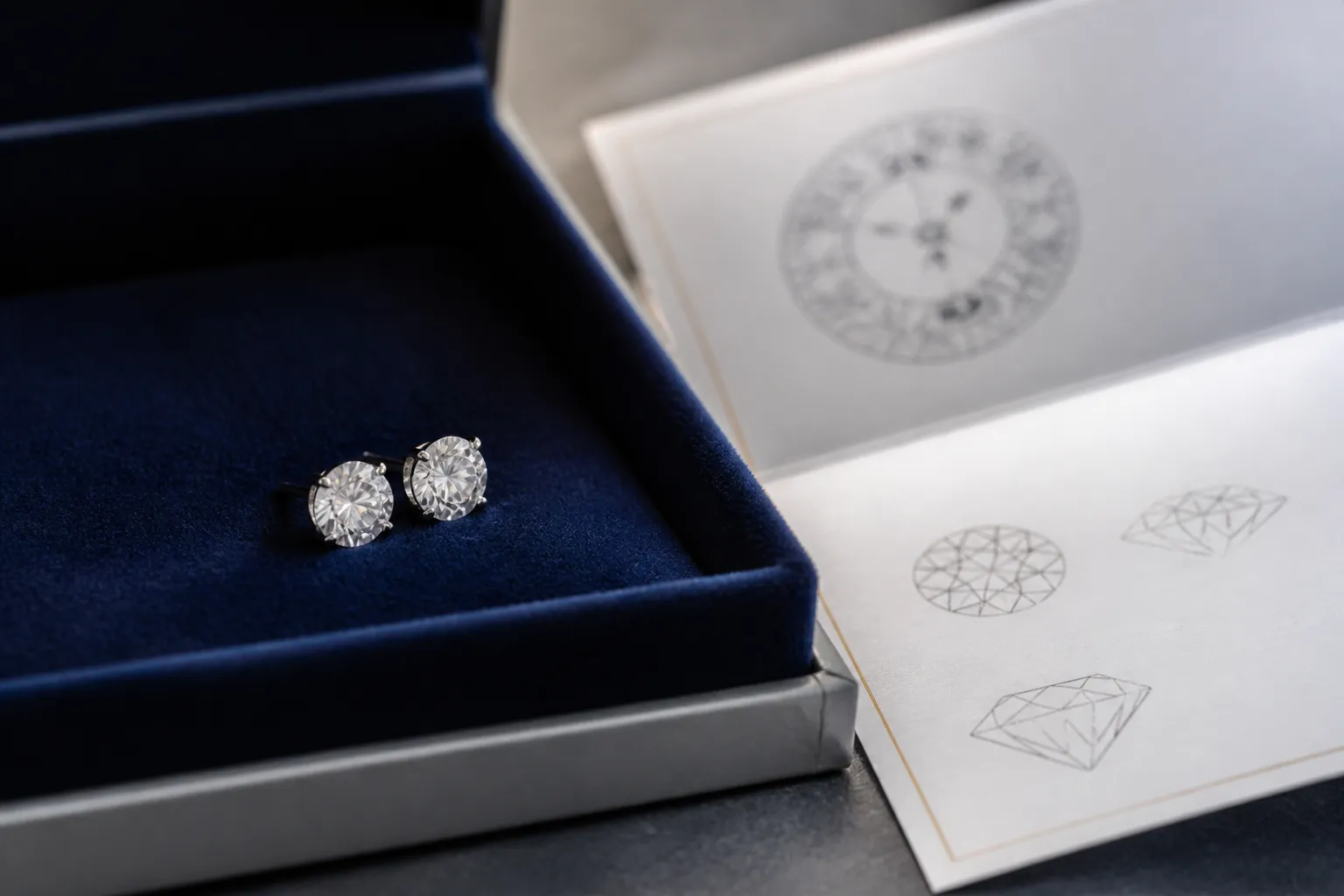
The United States is the world's largest consumer market for diamond jewelry, and lab grown diamonds have carved out a rapidly expanding share of that demand. Industry estimates suggest lab grown diamonds now represent 15–20% of total diamond jewelry retail sales in the US — a figure that has roughly doubled over the past three years as consumer awareness, celebrity endorsements, and aggressive retail pricing have converged. Lab grown diamond earrings, particularly stud and drop styles, rank among the fastest-moving SKUs in this category because they occupy a sweet spot: they look identical to mined diamonds under any standard jeweler's inspection, yet retail at a fraction of the price.
Demand is concentrated across several distinct buyer profiles. Retail consumers — primarily millennial and Gen Z women aged 25–45 — are drawn by the ethics-and-value narrative: the same chemical composition as a mined diamond at 50–70% less cost, with a markedly smaller environmental footprint and no association with conflict supply chains. At the wholesale and procurement level, US-based independent jewelers, DTC e-commerce store owners, and specialty boutiques are actively sourcing lab grown diamond earring inventory from international manufacturers, including established workshops in China's jewelry production hubs. Importers and B2B buyers represent a second major profile — these are procurement managers and store owners hunting for reliable overseas suppliers who can deliver certified, consistent product on repeatable order cycles.
For sourcing-focused buyers, the US market's sheer scale creates both opportunity and complexity. Margins on lab grown diamond jewelry can be compelling for retailers who secure competitive factory pricing, but the sourcing journey — vetting overseas suppliers, navigating import compliance, managing QC at distance — requires genuine due diligence. That's why Hangzhou-based suppliers like STRAND have built multilingual procurement infrastructure specifically targeting US buyers: the ability to communicate clearly in English, quote transparently, and ship compliant, QC-verified product directly to American importers is no longer a differentiator — it's a table stake.
What's Specific About the United States
Regulatory and Compliance Environment
The US regulatory landscape for imported diamond jewelry is structured but navigable when you know the frameworks. Key considerations include:
- FTC Jewelry Guides (16 CFR Part 23): The Federal Trade Commission requires that lab grown diamonds be clearly disclosed as laboratory-created. Any supplier marketing or labeling that omits this disclosure — or implies the product is "natural" or "mined" — is a compliance violation. US retailers importing from overseas manufacturers must ensure product descriptions, certificates, and hang tags use FTC-compliant language ("lab-created diamond," "laboratory-grown diamond," or "cultured diamond").
- Kimberley Process & Conflict-Free Documentation: While lab grown diamonds inherently sidestep the Kimberley Process (which governs mined rough diamonds), US buyers should still request clear documentation from suppliers confirming the stones' laboratory origin to support their own retail disclosures.
- Customs Tariff Classification: Lab grown diamond earrings typically fall under HTS code 7104.20 (synthetic or reconstructed precious stones) or 7113 series (jewelry of precious metal). Tariff rates and any applicable Section 301 duties depend on country of origin; buyers importing from China should verify current duty rates with a licensed customs broker before finalizing supplier negotiations.
- Hallmarking & Metal Purity: The US does not mandate precious metal hallmarking the way the UK or EU do, but misrepresentation of metal purity (e.g., labeling 14k-plated as solid 14k gold) violates FTC guidelines. US buyers should request mill certificates or assay reports for metal content.
- Grading Certification: While not legally required, US consumers strongly expect lab grown diamonds to carry grading reports from recognized labs — IGI (International Gemological Institute), GIA (Gemological Institute of America), or GCAL are the most widely trusted. Sourcing uncertified lab grown diamonds will disadvantage US retailers significantly.
Cultural and Market Norms
American buyers — both retail and B2B — place high value on product transparency, responsive English-language communication, and clear return/dispute policies. Business negotiations tend to be direct; US procurement teams appreciate concise quotes, itemized pricing (per unit, per carat weight, per metal type), and defined lead times rather than open-ended discussions. Sustainability credentials (recycled metals, carbon-neutral production claims) resonate strongly and are increasingly used as retail marketing points.
Payment Methods
Standard B2B payment methods for US importers sourcing from overseas manufacturers include:
- Wire transfer (T/T): Most common for established relationships, typically structured as 30% deposit + 70% before shipment.
- Letter of Credit (L/C): Used for larger orders where buyers want bank-backed payment security.
- PayPal / credit card: Common for smaller initial orders or sample purchases.
- Alibaba Trade Assurance: Many US buyers sourcing from Chinese manufacturers use this escrow-style protection for first orders.
How to Choose a Lab Grown Diamond Earrings Provider in the United States
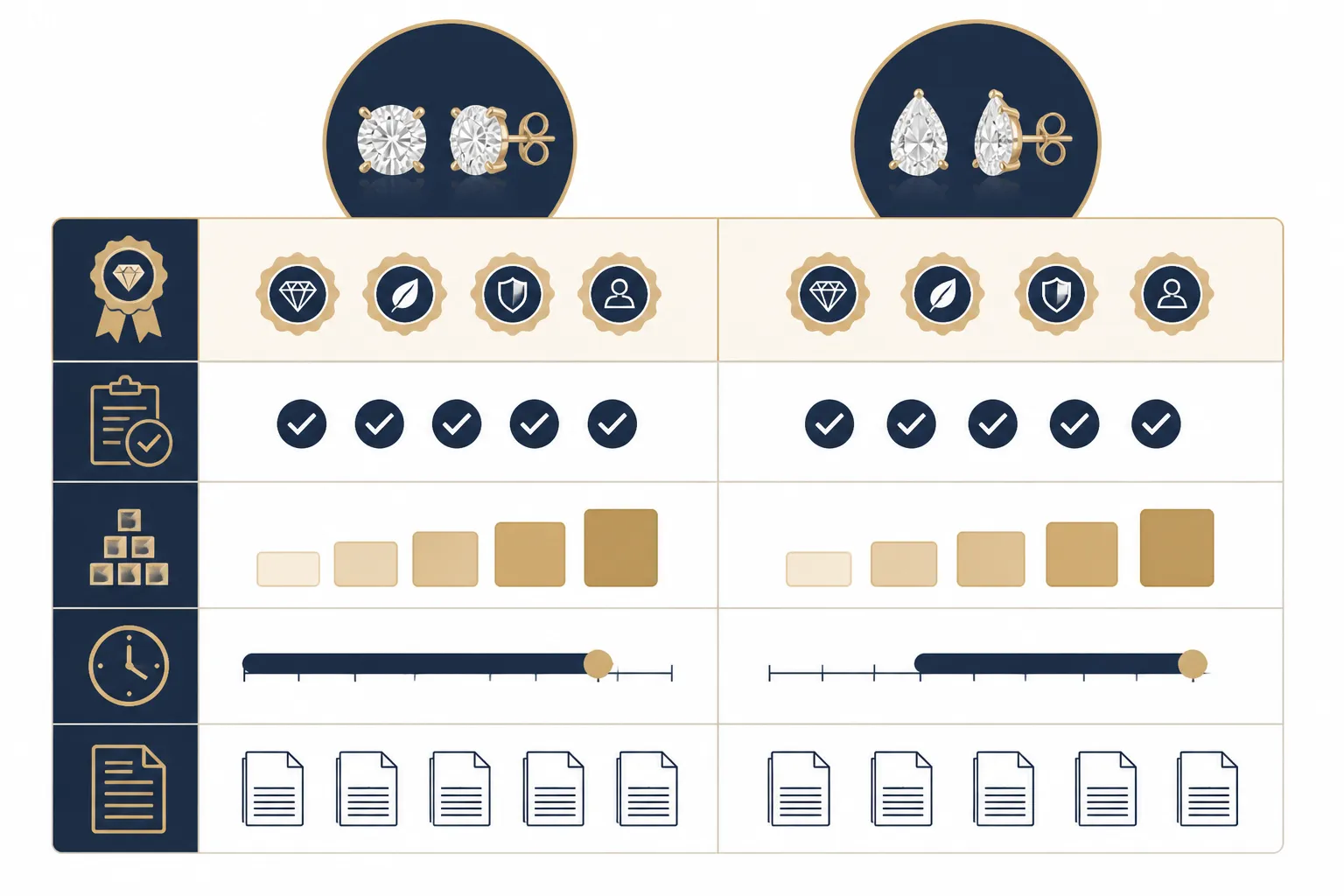
For US buyers — whether you're a DTC store owner, an independent jeweler building inventory, or a B2B importer — the supplier evaluation framework should cover these dimensions:
1. Certification and Grading Compliance
Prioritize suppliers who ship lab grown diamond earrings with IGI or GIA grading reports as standard. Ask: Do certificates accompany individual stones or lots? Are grading reports included in the unit price or quoted separately? FTC-compliant labeling should be non-negotiable.
2. Transparent Pricing and MOQ Structure
Reputable manufacturers will provide itemized quotes that separate stone cost (by carat weight and grade), metal cost (by alloy and weight), labor, and certifications. Ask for the minimum order quantity (MOQ) by SKU and by total order value — some factories have per-style MOQs while others apply a blanket minimum to the full order. Low-MOQ suppliers are particularly valuable for US DTC store owners testing new styles.
3. Quality Assurance Process
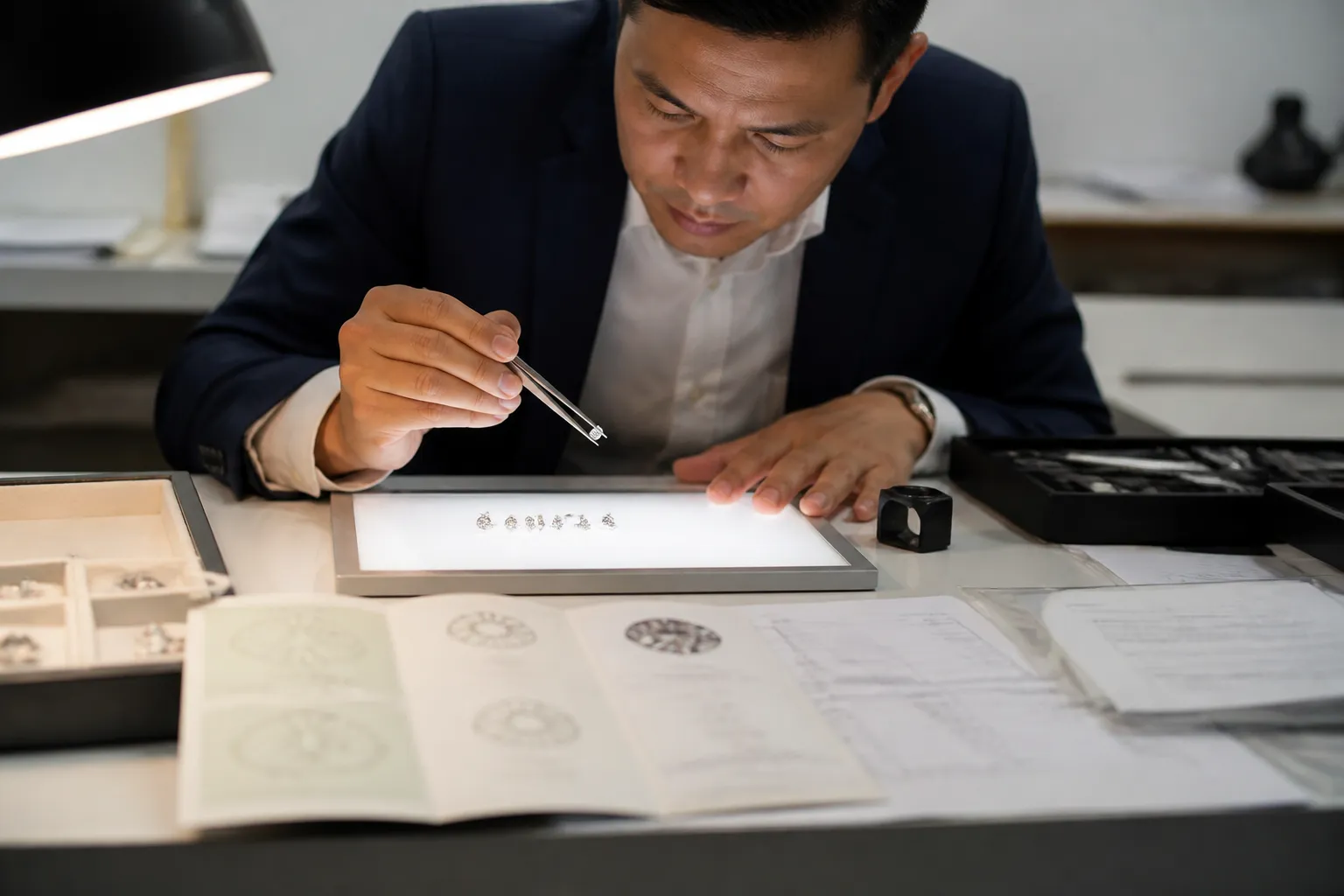
Request documentation of the supplier's QC process: Do they inspect stones for the "4Cs" (cut, color, clarity, carat) against the grading certificate before setting? Is there a final visual and dimensional inspection before packing? In-house QC — rather than reliance on self-reporting — is the meaningful differentiator.
4. Language and Time-Zone Coverage
US buyers lose significant time when communication gaps cause delays. Suppliers offering fluent English-language service across US business hours (or with dedicated account managers who bridge the time zone) substantially reduce sourcing friction. STRAND's multilingual team (English, Arabic, Spanish) is structured specifically to serve US, MENA, and EU procurement teams without the communication attrition that characterizes many factory-direct relationships.
5. Lead Time and Production Capacity
Standard lead times for custom OEM lab grown diamond earrings from Chinese workshops typically run 25–45 days depending on complexity and stone sourcing. Ask for a production capacity ceiling (units per month) and what happens during peak periods (Chinese New Year, Golden Week). Suppliers with verified workshop relationships can give you honest capacity answers; agents who broker through multiple factories often cannot.
6. Supplier Reliability Indicators
Request references from existing US buyers, ask for a sample order before committing to a production run, and look for suppliers with documented export history to the US. Verifiable logistics partners (DHL, FedEx, UPS international, or sea freight forwarders with US customs experience) are a positive signal.
Pricing in the United States
Lab grown diamond earring prices in the US vary substantially based on stone grade, metal type, and whether you're buying retail or at wholesale/import pricing.
Retail price ranges (USD, per pair):
- Entry-level lab grown diamond studs (0.25–0.50 ctw, SI1–SI2, 14k white gold): $150–$400
- Mid-range studs (0.50–1.0 ctw, VS2, 14k gold): $400–$1,200
- Premium studs or drop earrings (1.0+ ctw, VVS, 18k gold): $1,200–$5,000+
Wholesale/import pricing from manufacturer (USD, indicative ranges):
- Simpler stud styles at low-to-mid carat weights may wholesale at 30–55% of US retail depending on stone grade and metal content.
- Custom OEM styles with unique settings will carry tooling/mold costs for initial orders; per-unit cost drops meaningfully at volume.
Key pricing drivers:
- Carat weight and cut grade of the lab grown diamond (CVD vs. HPHT process, color/clarity grade)
- Metal type and weight: 14k vs. 18k; white gold, yellow gold, or rose gold; rhodium plating
- Certification: IGI-certified stones command a premium but are essentially required for US retail
- Setting complexity: Prong, bezel, halo, pavé each carry different labor costs
- Order volume: Per-unit cost falls meaningfully as MOQ tiers increase
US import duties and freight costs (typically 3–8% of CIF value for air freight from China) should be factored into landed cost calculations before comparing factory pricing against domestic wholesale.
Common Challenges for Buyers in the United States
Logistics and Customs Clearance
Importing jewelry from overseas manufacturers into the US involves customs classification, bond requirements for commercial shipments, and occasional CBP holds for additional inspection. Lab grown diamond earrings must be correctly classified under the appropriate HTS code to avoid reclassification penalties. Working with a licensed customs broker is advisable for first-time importers. Air freight is standard for high-value jewelry; sea freight is rarely used due to value density. Transit times from Chinese manufacturers via air run 3–7 days after production completion.
FTC Compliance and Labeling
US retailers who import lab grown diamond earrings must ensure that all marketing copy — website listings, hang tags, invoices, and any certificates included with the product — uses FTC-compliant disclosure language. Suppliers unfamiliar with US regulatory requirements may not provide labeling that meets FTC Jewelry Guide standards. Buyers should provide their supplier with explicit labeling specifications rather than assuming compliance.
Supplier Reliability and Consistency
The core challenge of factory-direct sourcing is batch-to-batch consistency. A sample may be excellent; production units may vary in stone color, metal finish, or dimensional tolerance. Structural solutions include: pre-shipment inspection (PSI) performed by a third party like SGS or Bureau Veritas, or reliance on suppliers with documented in-house QC programs. STRAND's model — vetted workshop relationships with in-house QC before shipment — is specifically designed to address this pain point for overseas buyers who cannot visit Chinese factories themselves.
Communication and Time-Zone Friction
A 12–15 hour time difference between China and US business hours means that unresolved questions can slip a full business day per exchange. This compounds quickly during sampling or production: a five-question back-and-forth that could be resolved in an hour face-to-face can stretch to a week. Suppliers with dedicated English-speaking account managers who respond within US business hours materially compress the sourcing timeline.
Minimum Order Quantity Mismatch
Many Chinese jewelry manufacturers set MOQs at levels appropriate for large wholesale distributors, not DTC store owners testing new categories. A retailer looking to trial lab grown diamond earrings with 20–50 pairs per style will struggle to find factory-direct pricing without suppliers who have specifically structured low-MOQ programs. This is an area where purpose-built B2B suppliers distinguish themselves from commodity factories.
Frequently Asked Questions (United States-Specific)
Q: Are lab grown diamond earrings legal to sell in the United States? Yes. Lab grown diamonds are fully legal to sell in the US. The FTC requires clear disclosure that diamonds are laboratory-created, but there are no restrictions on their sale or import. They carry the same legal standing as mined diamonds for jewelry purposes.
Q: Do lab grown diamond earrings hold their value in the US resale market? Lab grown diamonds have depreciated significantly in resale value over recent years as production costs have dropped and supply has expanded. For US buyers purchasing as a personal gift or fashion purchase, this is often acceptable given the upfront cost savings. For investment-minded buyers, mined diamonds retain stronger resale value, though neither category is considered a liquid investment.
Q: What certifications should I require when importing lab grown diamond earrings to the US? IGI grading reports are the US market standard for lab grown diamonds and the most widely recognized by US retailers and consumers. GIA now grades lab grown diamonds as well. Ensure each certificate matches the stone it accompanies (laser inscription on the girdle is standard). For the metal component, request mill certificates confirming alloy composition.
Q: What US import duties apply to lab grown diamond earrings from China? HTS classification matters. Finished jewelry (HTS 7113 series) carries a standard duty rate, plus any applicable Section 301 tariffs on Chinese-origin goods — rates that have been subject to policy changes and should be verified with a licensed US customs broker before committing to import volumes. Lab grown stones alone (HTS 7104) carry different rates.
Q: What's a realistic lead time when ordering lab grown diamond earrings from a Chinese manufacturer for a US DTC store? For in-stock or near-stock styles, manufacturers may ship within 7–14 days. For custom OEM production — new styles, custom settings, branded packaging — lead times typically run 25–45 days from order confirmation to quality-approved shipment. Add 3–7 days for air freight to the US. Planning inventory 6–8 weeks ahead of your sales window is advisable.
Q: Can I get branded packaging for lab grown diamond earrings sourced from China? Yes. Most OEM-capable manufacturers offer custom packaging — branded boxes, pouches, hang tags, and inserts — as part of the OEM scope. Minimum quantities for custom packaging may differ from jewelry MOQs. Confirm that hang tag language will meet FTC disclosure requirements before approving packaging proofs.
Q: How do I verify that a Chinese supplier's lab grown diamonds are actually lab grown and not simulants? Require IGI or GIA grading reports for every lot. Both laboratories specifically identify lab grown diamonds by growth method (CVD or HPHT) and distinguish them from simulants (moissanite, cubic zirconia). Pre-shipment inspection by a third-party service (SGS, Intertek, Bureau Veritas) with gemological verification is an additional safeguard for large orders.
Get Started in the United States
If you're a US-based retailer, DTC store owner, or B2B importer evaluating lab grown diamond earrings as a product category, the sourcing decision ultimately comes down to three things: a supplier with the right certifications and QC infrastructure, communication that doesn't bleed days through time-zone friction, and pricing structures that match your order volume.
STRAND is a Hangzhou-based jewelry brand built specifically for overseas buyers in the US, EU, UK, and MENA. Its direct workshop relationships, in-house QC program, and multilingual team (English, Arabic, Spanish) are structured to give US procurement buyers what factory-direct sourcing often lacks: responsive communication, transparent pricing, and product that arrives compliant and consistent.
Concrete next steps for US buyers:
- Define your category scope — stud earrings, drop earrings, or necklace-and-earring sets? Identify 3–5 styles you want to pilot.
- Request a sample order before committing to a production run. Evaluate stone clarity, metal finish, setting quality, and whether IGI certificates match stones as described.
- Confirm FTC labeling requirements with your supplier in writing — hang tags, certificates, and website copy must use compliant disclosure language.
- Get your landed cost right — factor in unit price, certification, packaging, freight, US import duties, and customs broker fees before modeling margins.
- Establish a reorder cadence — lab grown diamond pricing has been volatile; locking in forward pricing agreements with a reliable supplier protects your retail margins.
Ready to source lab grown diamond earrings for the US market?
Request a Quote — Get MOQ & Pricing →
Contact STRAND's multilingual procurement team to discuss your style requirements, request a sample, or get a transparent factory quote with lead time and certification details. Low MOQ options available for DTC store owners and independent jewelers testing the category.
This guide is intended for informational purposes for buyers, importers, and retailers evaluating lab grown diamond earrings for the US market. Regulatory details (FTC guidelines, HTS codes, Section 301 tariffs) are subject to change — verify current requirements with qualified legal and customs counsel before importing.