
Kendra Scott Earrings: Cross-Border Sourcing Guide for DTC & OEM Buyers
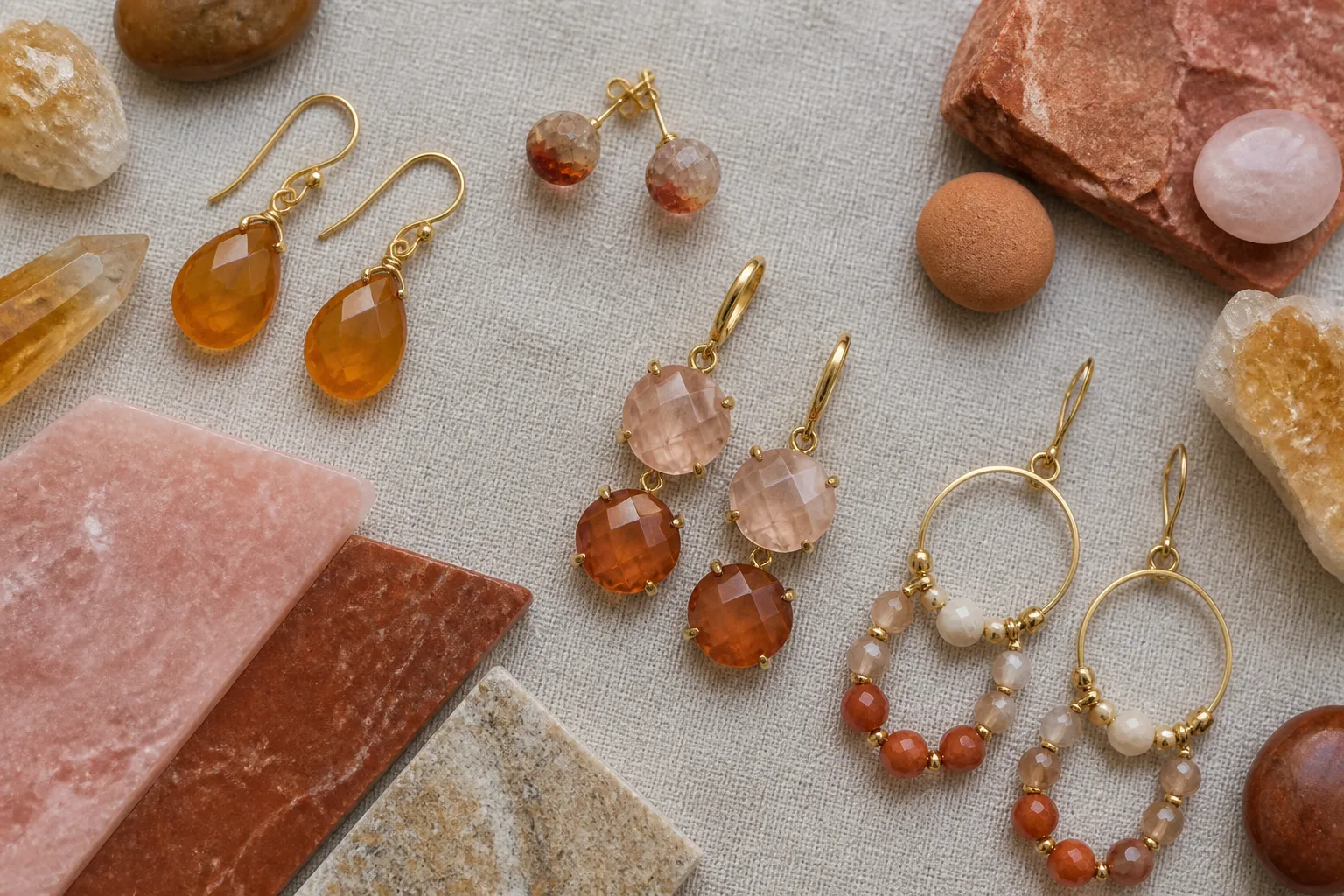
Kendra Scott Earrings: Cross-Border Sourcing Guide for DTC & OEM Buyers
How fashion jewelry buyers in the US, EU, UK, and MENA can identify, source, and scale Kendra Scott-inspired earring styles through vetted Chinese manufacturing partnerships
The Cross-Border Fashion Jewelry (DTC + OEM) Reality
The global fashion jewelry market doesn't operate on a single clock. A DTC brand in Dallas finalizing its autumn drop, an importer in Dubai building a private-label accessories line, and a boutique chain buyer in Manchester planning a Valentine's season refresh are all navigating the same upstream challenge: identifying which aesthetic is resonating, understanding why it sells, and getting production-ready fast enough to capitalize on the trend window.
Kendra Scott earrings have become a reference point that transcends geography. The brand's signature approach — oversized gemstone drops, hammered metal frames, color-blocked beaded styles, and the unmistakable mix of bohemian warmth with polished finish — has defined a taste profile that buyers across markets now use as a shorthand when briefing manufacturers. When a procurement team says "we want something in the Kendra Scott earrings direction," they mean a specific silhouette language: lightweight drop structures, statement stones, warm gold or rose-gold hardware, and pieces that photograph well for e-commerce. That brief travels across time zones every day.
What makes cross-border fashion jewelry procurement genuinely complex is the gap between trend identification and production reality. Lead times from Chinese workshops typically run 30–60 days for custom OEM. Trend cycles in the DTC space can compress to 8–12 weeks from pin to purchase. Add multilingual supplier communication, split shipments across FBA warehouses, customs documentation for multiple destination markets, and the coordination pressure on a small sourcing team becomes substantial. Buyers who navigate this well don't do it by luck — they build structured supplier relationships with partners who understand both the aesthetic and the logistics.
Why Generic Solutions Fall Short for Cross-Border Fashion Jewelry (DTC + OEM)
Most sourcing platforms treat fashion jewelry the same way they treat industrial components: SKU, unit price, MOQ, lead time. That framework collapses the moment aesthetics enter the equation. A turquoise drop earring and a sapphire drop earring are not interchangeable SKUs — they occupy different seasonal positions, different price-point expectations, and different photography requirements for different destination markets. Generic B2B marketplaces have no mechanism for this.
The Kendra Scott earrings category specifically illustrates the problem. The brand's design language relies heavily on stone quality, finish consistency, and silhouette proportion. When buyers try to source comparable styles through generic channels — a quick Alibaba search, an unvetted factory contact from a trade show — they routinely receive samples where the stone color is off, the plating is inconsistent batch-to-batch, or the earring weight is wrong for the intended hook gauge. These are not abstract quality concerns. A DTC store owner gets a 1-star review because the earrings photographed beautifully but felt cheap on the ear. A European importer gets a compliance rejection because the plating contains nickel above the EU REACH threshold. Generic sourcing produces generic outcomes.
The OEM layer adds another dimension that off-the-shelf platforms miss entirely. A buyer who wants to build a house brand in the Kendra Scott aesthetic — custom colorways, proprietary stone cuts, branded packaging — needs a manufacturing partner with design collaboration capability, not just a price list. That means CAD support, sample iteration cycles, custom packaging MOQ flexibility, and a QC process that catches finish defects before the container ships. Most generic platforms cannot surface this capability reliably.
Cross-border teams also operate across languages and legal frameworks simultaneously. A MENA distributor needs Arabic documentation. An EU buyer needs REACH and RoHS compliance paperwork. A UK importer post-Brexit needs updated rules-of-origin declarations. A sourcing partner who handles only English-language documentation creates downstream friction at every customs clearance.
Core Use Cases: Kendra Scott Earrings in the Cross-Border Sourcing Workflow
1. Trend-to-Sample: Translating the Kendra Scott Aesthetic into an OEM Brief
The problem: A DTC brand founder identifies that Kendra Scott's elongated ellipse drop earrings are trending on Pinterest and TikTok shop. She needs to develop a house-brand version — same silhouette proportion, different colorway, her own branding — within a 45-day window before the seasonal window closes.
How this use case plays out: The brief goes to an OEM partner with design collaboration capability. A vetted Hangzhou-based workshop with in-house CAD support can translate a reference image and a colorway brief into a production-ready sample within 7–14 days. The buyer reviews the sample, requests adjustments (stone shade, hardware finish, hook length), and approves a revised sample before committing to a production run. The entire iteration cycle happens over email and video call — no travel, no trade show.
What success looks like: Sample approval within 2 revision cycles. Production sample matches approved sample within a defined color-delta tolerance. First shipment clears customs without compliance holds.
Example scenario: A US DTC store owner sends a mood board referencing Kendra Scott's Elisa pendant earrings in terracotta and requests a gradient crystal version in burgundy-to-amber with a brass-finish frame. The workshop returns a wax sample within 10 days. Two revision cycles later, she has an approved sample and places a 12 pcs unit production order.
2. Category Expansion: Building an Earrings Line Around a Proven Aesthetic
The problem: An established accessories importer in the UK has built a necklace business but wants to add earrings to increase average order value. The Kendra Scott earrings category — specifically the mix of stud options, drop styles, and necklace-and-earring sets — demonstrates that a cohesive earring line can anchor a whole brand identity rather than functioning as an afterthought.
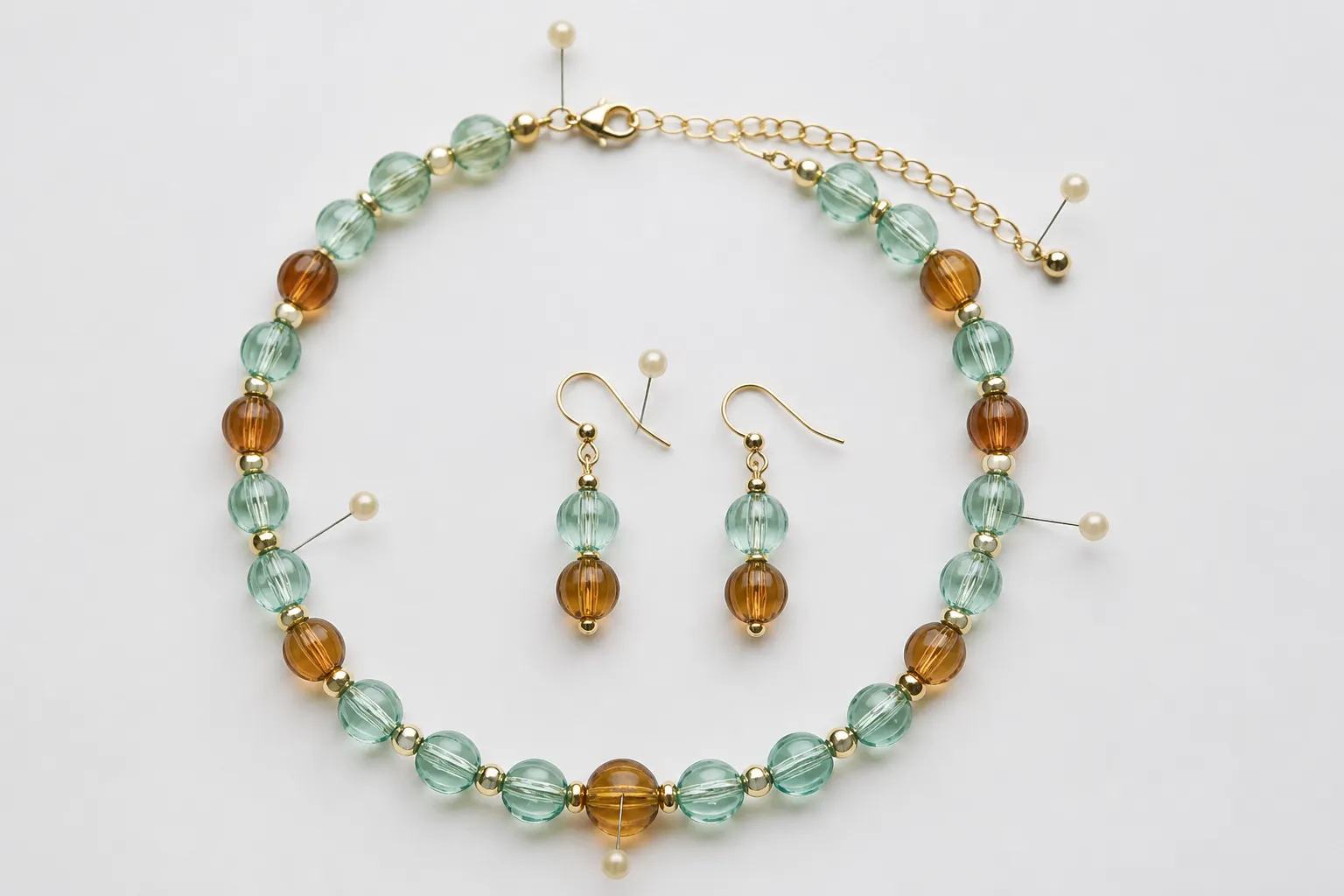
How this use case plays out: Rather than sourcing earrings from a different supplier than their necklace partner, the importer works with an OEM partner who can produce matched sets. Two-tone glass bead drop earrings paired with a matching necklace, rhinestone stud clusters coordinated with a pendant — these necklace-and-earring sets allow the importer to list higher-ASP bundles, improve perceived value, and simplify their own inventory management by consolidating suppliers.
What success looks like: 20–30% higher average order value on bundled listings versus individual pieces. Reduced SKU complexity because one OEM partner produces the full category. Consistent finish across earrings and necklaces in the same collection, which matters enormously for editorial photography.
Example scenario: A Manchester-based accessories wholesaler consolidates their earring and necklace sourcing with STRAND, ordering vintage-style rhinestone stud earrings alongside coordinated choker sets. The result is a cohesive autumn lookbook they can use across their wholesale catalog and DTC website, shot in a single photography session.
3. Compliance-First Sourcing: EU and UK Market Entry for Fashion Earrings
The problem: A German accessories brand wants to import fashion earrings from China but has been burned before by nickel content violations under EU REACH Regulation (EC) No 1907/2006. Kendra Scott earrings set a standard that US consumers associate with quality — but EU compliance requirements add a layer of material specification that most US-market factories don't default to.
How this use case plays out: A vetted OEM partner with experience in EU market sourcing will, by default, specify nickel-free plating, provide material test reports (MTR) from accredited labs, and include the relevant safety documentation in the export package. The buyer doesn't need to chase compliance paperwork after the fact — it's built into the production spec from the brief stage.
What success looks like: Zero customs holds due to material compliance. MTR documents available for retail partner audits. Earrings clear CE marking requirements where applicable. No product recalls or marketplace delisting events.
Example scenario: A Frankfurt-based online accessories retailer specifies "nickel-free brass base, 18K gold PVD coating" in their OEM brief. The workshop returns a material compliance certificate alongside the approved sample, and the shipment clears Hamburg customs without incident.
4. Private Label Launch: Low MOQ Entry for New DTC Brands
The problem: A first-time DTC founder in the US wants to launch a jewelry brand inspired by the Kendra Scott earrings aesthetic — statement drops, colorful stones, bohemian-meets-polished positioning — but can't commit to the 500–1,000 unit MOQs common in traditional OEM. She needs a path to market that lets her test demand before scaling.
How this use case plays out: Low-MOQ OEM partnerships allow new brands to enter with 12 pcs units per style, validate which colorways sell, and reorder into higher volumes as demand confirms. This is distinct from dropshipping — the buyer owns branded inventory, controls quality, and builds a defensible product. The risk is managed by keeping initial SKU count tight (3–5 hero styles) rather than launching a full catalog.
What success looks like: First collection launches with 3–5 styles. Sell-through rate of 60%+ within 90 days confirms market fit. Reorder placed at 2–3x initial volume. Hero style identified for custom colorway development in season two.
Example scenario: A Shopify-based founder launches with five drop earring styles in vintage gradient crystal and two-tone glass bead configurations. After 60 days, her burgundy crystal drops are nearly sold out. She places a reorder at 3x the original volume and commissions a custom sage-green colorway exclusive to her brand.
5. Multilingual Procurement: Managing Cross-Border OEM Across Time Zones and Languages
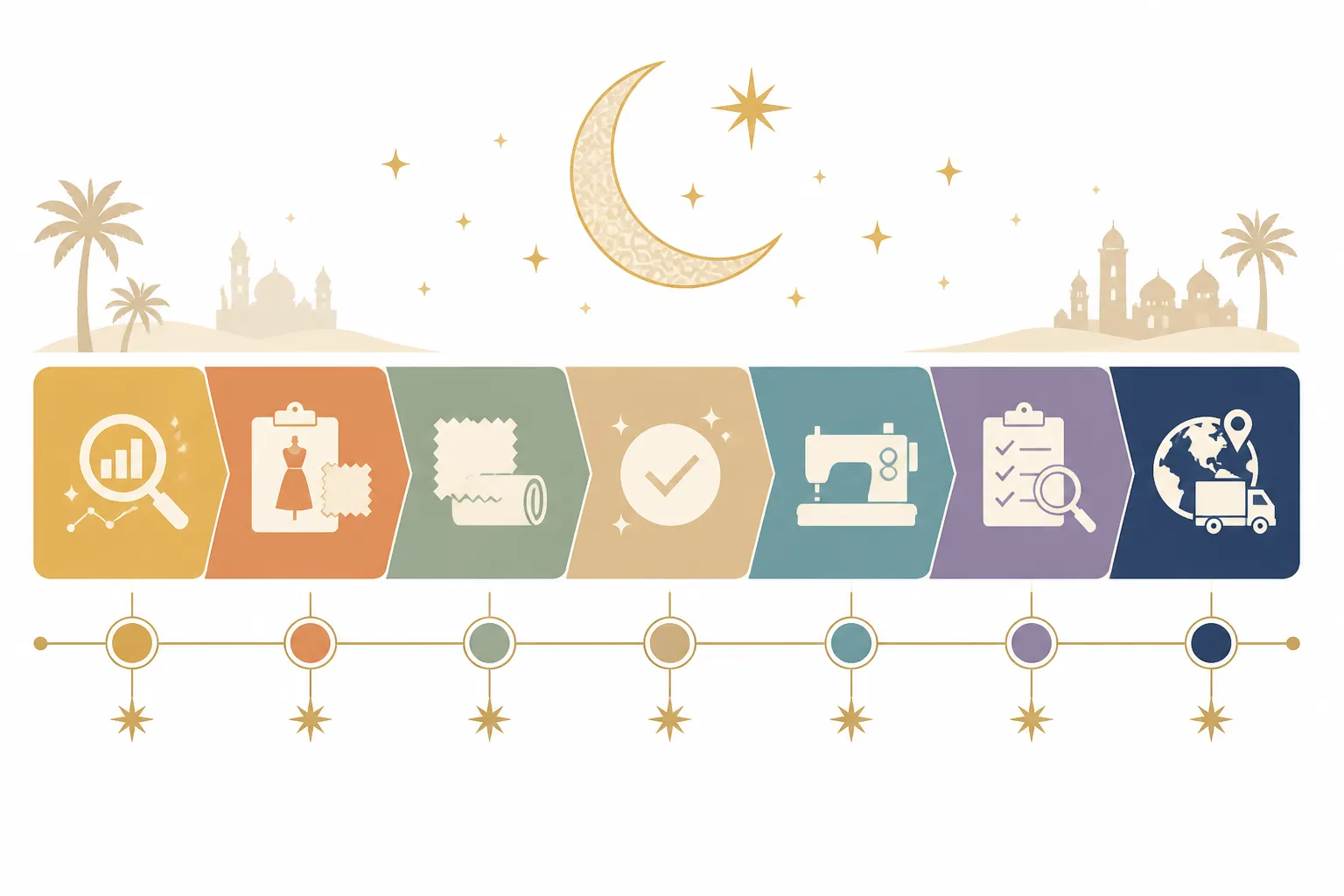
The problem: A MENA-based distributor importing fashion earrings for the Gulf retail market needs supplier communication in Arabic, trade documentation that meets Gulf Cooperation Council (GCC) import requirements, and a supplier who understands that Ramadan buying cycles require inventory to land in-market 8–10 weeks before the season — not 4 weeks.
How this use case plays out: A Hangzhou-based OEM partner with dedicated Arabic-language account management can receive briefs, confirm specifications, and handle production updates without translation lag. GCC-compliant commercial invoices, certificates of origin, and packing lists are prepared to spec. The production calendar is built backward from the GCC customs clearance window, not from a generic "30-day lead time" assumption.
What success looks like: Zero miscommunication-related production errors. Documentation package accepted by GCC customs on first submission. Inventory lands in the Dubai distribution center 8 weeks before Eid Al-Fitr.
Example scenario: A Riyadh-based accessories distributor briefs a new drop earring collection in Arabic via WhatsApp, including reference images of the Kendra Scott-adjacent stone sizes and gold hardware they need. The OEM partner confirms specifications in Arabic within 24 hours, and the production timeline is built around the Eid window.
6. Platform-Ready Inventory: Sourcing Kendra Scott-Style Earrings for Amazon and Marketplaces
The problem: An Amazon FBA seller wants to build a fashion earrings brand that competes in the same search space as Kendra Scott earrings — same aesthetic tier, lower price point — but needs inventory that is CPSC-compliant, photo-ready, and arrives at the FBA warehouse in Amazon-compliant packaging.
How this use case plays out: An OEM partner experienced in marketplace supply chains produces earrings with FBA-ready poly bags, FNSKU labels, suffocation warning labels, and carton dimensions that comply with Amazon's receive guidelines. The product itself meets Consumer Product Safety Improvement Act (CPSIA) requirements for jewelry sold in the US market. The buyer doesn't need to repack inventory on arrival — it ships direct from the Chinese workshop to the FBA warehouse.
What success looks like: Zero FBA receiving rejections. Products pass Amazon's restricted product checks. Listing images from factory sample shots convert at 3–5% CTR on search results pages. First review cycle produces 4.0+ star average within 60 days of launch.
Example scenario: A US Amazon seller sources a 6-style drop earring collection, receives factory samples with FBA-compliant packaging already applied, and ships directly to an Amazon fulfillment center in New Jersey. The collection goes live within 5 days of arrival.
Considerations Specific to Cross-Border Fashion Jewelry (DTC & OEM)
Regulatory & Compliance
Fashion earrings sold in the US, EU, UK, and MENA markets face overlapping and sometimes conflicting regulatory requirements. EU REACH limits nickel release to 0.2 μg/cm²/week for earring post assemblies (0.5 μg/cm²/week for other items in prolonged skin contact) — a standard that eliminates most conventional brass plating unless specifically treated. UK regulations post-Brexit mirror EU REACH but are administered separately. CPSIA in the US addresses lead and phthalate content in children's jewelry (under 12) but also shapes buyer expectations for adult fashion jewelry.
When briefing any OEM partner, buyers should request:
- Material test reports (MTR) from an accredited third-party lab (SGS, Intertek, Bureau Veritas)
- Nickel release test results if selling in the EU or UK
- REACH compliance declaration covering substances of very high concern (SVHCs)
- Country of origin documentation for customs purposes
GCC import requirements for fashion jewelry typically require a certificate of origin and a commercial invoice in Arabic for clearance in Saudi Arabia and the UAE. Buyers should confirm their OEM partner's documentation capability before placing a first order.
Integration with Industry-Standard Tools
Cross-border fashion jewelry buyers typically manage procurement across a stack that includes Shopify or WooCommerce (DTC storefront), Amazon Seller Central (marketplace), ShipStation or Flexport (logistics visibility), and some combination of Google Sheets or Notion for SKU and order tracking. An OEM partner who can provide production status updates in a format that integrates with these tools — or at minimum, structured reporting that a small team can process without a dedicated ops role — meaningfully reduces administrative overhead.
EDI capability is less common in the fashion jewelry OEM segment than in apparel, but buyers sourcing at scale (10,000+ units per season) should ask about structured order confirmation and advance ship notice (ASN) formats.
Data Sensitivity
Design files, colorway specifications, and brand identity assets sent to an OEM partner represent proprietary IP. Buyers should request a signed Non-Disclosure Agreement (NDA) before sharing any unreleased design work, and should understand their OEM partner's policy on design exclusivity — whether a custom style is sold to other buyers after the exclusivity period or held permanently.
Scale & Seasonality
Fashion earrings have pronounced seasonal demand curves. In the US and EU, Q4 (October–December) represents disproportionately high volume driven by holiday gifting. Valentine's Day (February), Mother's Day (May), and back-to-school (August) create secondary peaks. In MENA, Ramadan/Eid and National Day periods drive equivalent demand spikes.
Production lead times of 30–60 days for custom OEM mean that buyers need to place Q4 orders no later than August, and Eid orders no later than February. Buyers who miss these windows are forced into ready-made inventory — which typically offers less design differentiation — or into air freight, which compresses margins significantly. Building a seasonal production calendar with your OEM partner, agreed in advance, is the single most effective way to avoid both problems.
Implementation Roadmap for Cross-Border Fashion Jewelry (DTC + OEM) Teams
Phase 1 — Pilot (Weeks 1–8)
- Define your hero style brief: reference aesthetics (e.g., Kendra Scott earrings silhouettes), target colorways (2–3), hardware finish (gold / rose gold / silver), and retail price point.
- Request samples from 2–3 qualified OEM partners. Evaluate on: stone color accuracy, plating consistency, hardware weight, hook gauge, and packaging presentation.
- Select a primary OEM partner. Sign an NDA. Confirm compliance documentation capability for your target market(s).
- Place a pilot order at 12 pcs. Evaluate production sample against approved sample before authorizing shipment.
- Receive pilot inventory. Photograph, list, and begin selling. Track sell-through rate and early customer feedback.
Phase 2 — Pilot Orders & Range Expansion (Weeks 9–20)
- Based on pilot sell-through data, identify 2–3 hero styles for season-two development.
- Commission custom colorways or proprietary stone cuts for differentiation. Begin exclusivity negotiation if volume warrants.
- Build a seasonal production calendar: map lead times against your key sales peaks. Place forward purchase orders for Q4 or peak season.
- Expand SKU count systematically: add stud variants and necklace-and-earring sets to increase average order value.
- Establish QC protocols: agree on acceptable defect rate, define rework vs. rejection triggers, and confirm in-house QC is completed before shipment.
Phase 3 — Full-Catalog Scale (Weeks 21+)
- Formalize the supplier relationship with a framework agreement covering pricing tiers, lead time commitments, and exclusivity terms.
- Integrate supplier reporting into your logistics stack (Flexport, ShipStation, or equivalent).
- Expand to additional destination markets: if you've proven the EU market, model out MENA or UK entry using the same OEM relationship with documentation adapted for the new market.
- Develop a second OEM relationship for supply chain redundancy — critical if single-supplier dependency creates risk during Chinese national holidays (Chinese New Year, Golden Week).
ROI & Business Outcomes for Cross-Border Fashion Jewelry (DTC + OEM) Teams
The financial case for structured OEM sourcing versus generic marketplace purchasing is measurable across several dimensions that matter in the fashion jewelry vertical:
Gross margin improvement: Custom OEM production typically yields 60–70% gross margins for DTC brands at mid-market price points (retail $28–$85), compared to 30–40% margins on resold branded product. The margin differential funds paid acquisition, influencer seeding, and photography — all essential to DTC customer acquisition.
Inventory turn efficiency: Brands that source with a defined seasonal calendar turn inventory 4–6x annually versus reactive sourcers who average 2–3x. In a category where trend half-life is short, faster turns reduce markdown exposure.
Compliance cost avoidance: A single EU customs hold or marketplace delisting event can cost more than an entire season's QC investment. Buyers who build compliance documentation into the OEM brief from day one avoid remediation costs that routinely run $5,000–$20,000 per incident when product must be recalled, retested, or destroyed.
Customer acquisition through differentiation: Selling a design that is exclusively yours — rather than a catalog item available from dozens of sellers — produces measurable listing performance advantages on Amazon and Shopify. Unique ASINs don't compete on price alone. Brands that develop even modest design differentiation through OEM consistently outperform resellers on review velocity and conversion rate.
Multilingual market expansion: A DTC brand that has proven its formula in the US can enter the MENA market without building a new supply chain from scratch if their OEM partner already handles Arabic documentation and GCC compliance. Market expansion cost drops significantly when the supplier relationship scales with you.
Conclusion: Procurement Next Steps for Cross-Border Fashion Jewelry Decision-Makers
The Kendra Scott earrings category has defined a taste profile that buyers worldwide now use as a design reference. The question for cross-border sourcing teams is not whether this aesthetic has global demand — it clearly does — but how to translate that demand into defensible, margin-positive inventory that arrives on time, clears customs, and earns repeat purchase.
The answer is a structured OEM relationship with a supplier who understands both the design language and the operational complexity of cross-border trade: low MOQ flexibility for new brand launches, compliance documentation built into the production process rather than chased after the fact, multilingual account management for MENA and Spanish-language markets, and an in-house QC process that catches finish defects before they become customer returns.
STRAND, based in Hangzhou and serving buyers in the US, EU, UK, and MENA, connects overseas buyers directly to vetted Chinese workshops producing drop earrings, stud earrings, and necklace-and-earring sets in vintage, gradient crystal, two-tone glass bead, and rhinestone styles — with custom OEM available at low MOQ and fast lead times.
Before your next seasonal purchase order, evaluate your current sourcing relationship against these criteria:
- MOQ flexibility: Can you test new styles without overcommitting capital?
- Sample iteration speed: How many revision cycles before an approved sample, and how many days per cycle?
- Compliance documentation: Are MTRs and compliance declarations provided as standard, or do you chase them?
- Multilingual capability: Can your supplier communicate in the language of your procurement team?
- QC before shipment: Is in-house quality control completed before the container loads, or does quality management happen at destination?
If your current partner falls short on any of these, the cost shows up in your margins, your compliance exposure, and your seasonal calendar stress.
Ready to evaluate your sourcing options for Kendra Scott-style earrings?
Request a Quote, Get MOQ & Pricing, or Request a Sample →
STRAND is a Hangzhou-based cross-border fashion jewelry brand connecting overseas buyers with vetted Chinese workshops. Multilingual service in English, Arabic, and Spanish. Transparent trade terms. OEM with low MOQ and in-house QC before shipping.