
Gold Stud Earrings: Cross-Border Sourcing & DTC Strategy Guide
Gold Stud Earrings: Cross-Border Sourcing & DTC Strategy Guide
The Cross-Border Fashion Jewelry (DTC + OEM) Reality
Gold stud earrings sit at the center of one of the most competitive product categories in global fashion accessories. Every season, buyers in the US, EU, UK, and MENA markets are scouring Chinese workshops, wholesale platforms, and OEM suppliers for that precise combination of look, price point, and repeatability that converts browsers into loyal customers. But the market is not monolithic. A DTC brand owner in Manchester building a curated Instagram-first store operates under completely different sourcing pressures than a MENA importer stocking multi-door retail chains or a US wholesale distributor trying to push SKU velocity across Amazon and TikTok Shop simultaneously. What unites all of them is the gold stud earring — compact, margin-friendly, universally giftable, and infinitely styleable.
The supply chain reality for cross-border fashion jewelry is tighter than most newcomers expect. China remains the dominant manufacturing base for fashion-grade gold stud earrings — from zinc alloy with gold electroplating to brass-core pieces finished in vacuum plating — but the quality gap between vetted OEM partners and random wholesale sourcing is enormous. Overseas buyers who have been burned by inconsistent plating thickness, unstable post-and-clutch mechanisms, or misrepresented stone grades understand this firsthand. For DTC operators running paid traffic to product pages, a single batch of earrings with flaking finish or discolored posts generates return rates and review damage that kills conversion for an entire collection.
Procurement teams sourcing gold stud earrings at scale also face the compounding pressure of trend velocity. What sells in Q4 holiday gifting may be stale by Valentine's Day. The ability to iterate styles — moving from classic round ball studs to gradient crystal studs to vintage-look rhinestone clusters — without blowing up minimum order commitments is a sourcing capability, not just a design decision. This is the operating environment where a well-structured OEM supplier relationship changes the economics of the entire DTC business.
Why Generic Sourcing Approaches Fall Short for Cross-Border Fashion Jewelry
The fashion jewelry category looks deceptively simple from the outside: small products, low per-unit cost, no moving parts. This apparent simplicity is exactly what leads buyers to underestimate the category-specific challenges that generic sourcing platforms and off-the-shelf wholesale directories routinely miss.
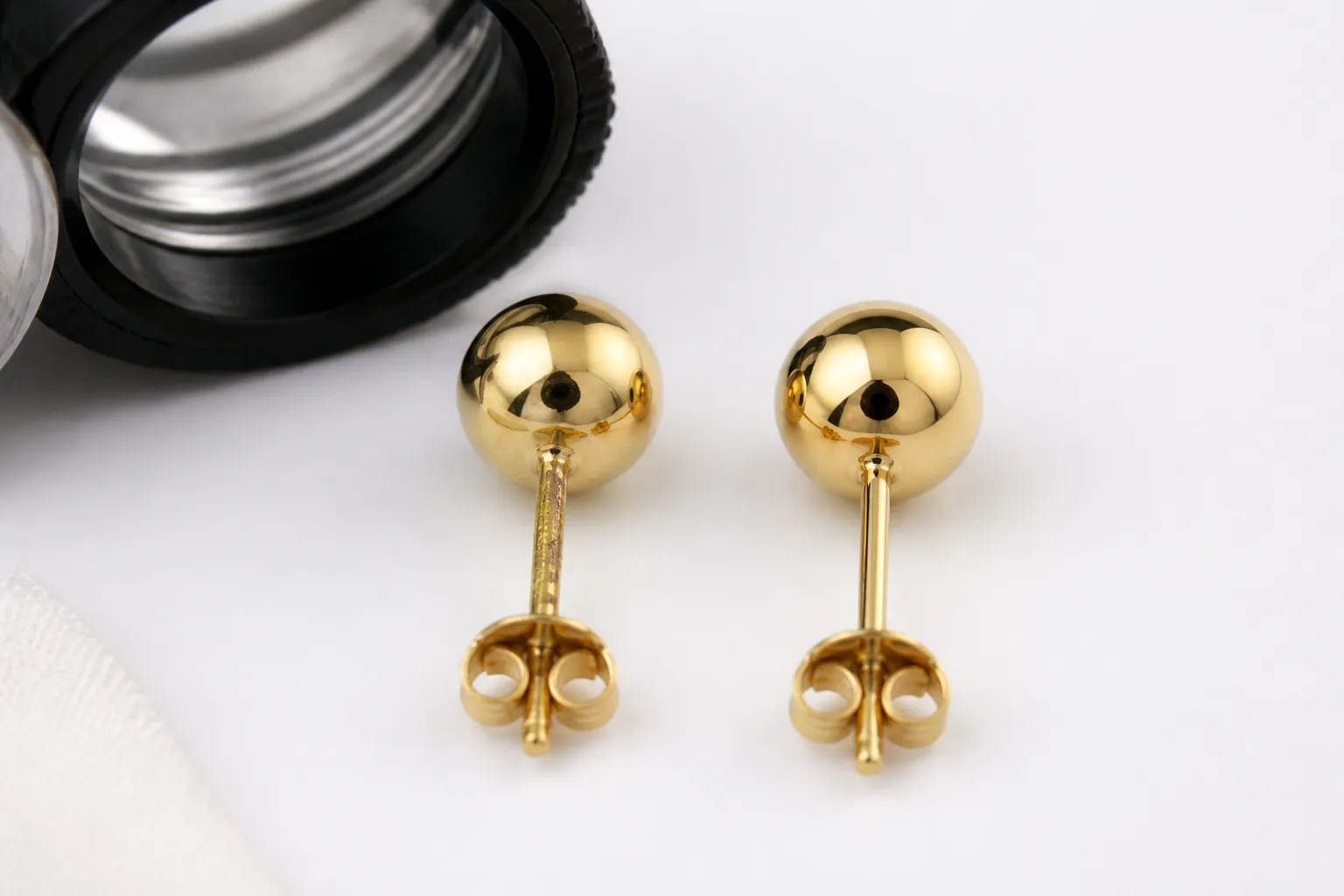
The gold plating problem is invisible until it isn't. Standard product listings rarely disclose plating thickness (measured in microns), base metal composition, or the plating process used (barrel plating vs. vacuum ion plating vs. flash plating). For fashion-grade gold stud earrings sold under a DTC brand with a quality promise, these variables directly determine customer experience. A supplier who plates at 0.3 microns will quote cheaper than one plating at 1.0+ microns — but neither spec appears on a generic marketplace listing. Buyers who do not know to ask, or who source from platforms without supplier verification, absorb this risk entirely.
Style iteration speed requires a different supplier relationship. Generic wholesale buying — picking from a static catalog — forces buyers to move with the supplier's development timeline, not market demand. In fashion jewelry, where a trending style can go from social media to peak search volume in under six weeks, that lag is a competitive disadvantage. OEM relationships with rapid sampling capability and low MOQ allow DTC brands to test new styles with small batches before committing to full production runs, then scale the winners within the same production cycle.
Multilingual procurement is a real operational constraint. Procurement teams in the MENA region, Spanish-speaking US markets, or EU-based distributors with mixed-language staff consistently run into friction sourcing from Chinese workshops because communication bottlenecks slow everything from sample feedback to quality dispute resolution. When a buyer's QC team identifies a problem with a batch of earrings — say, inconsistent stone setting on rhinestone studs — the ability to communicate that feedback clearly in Arabic, Spanish, or English, and receive a technically accurate response, is the difference between a one-time problem and a pattern of rejects.
Core Use Cases: Gold Stud Earrings Across Cross-Border Fashion Jewelry Operations
1. DTC Brand Catalog Building: Structuring a Stud Earring Range by Style Family
The problem: A DTC jewelry brand launching or refreshing its core earring category needs a coherent product range — not just a collection of unrelated studs — that holds together visually across packaging, photography, and product page merchandising. Sourcing individual styles from multiple suppliers fractures quality consistency and inflates per-unit cost by eliminating any volume leverage.
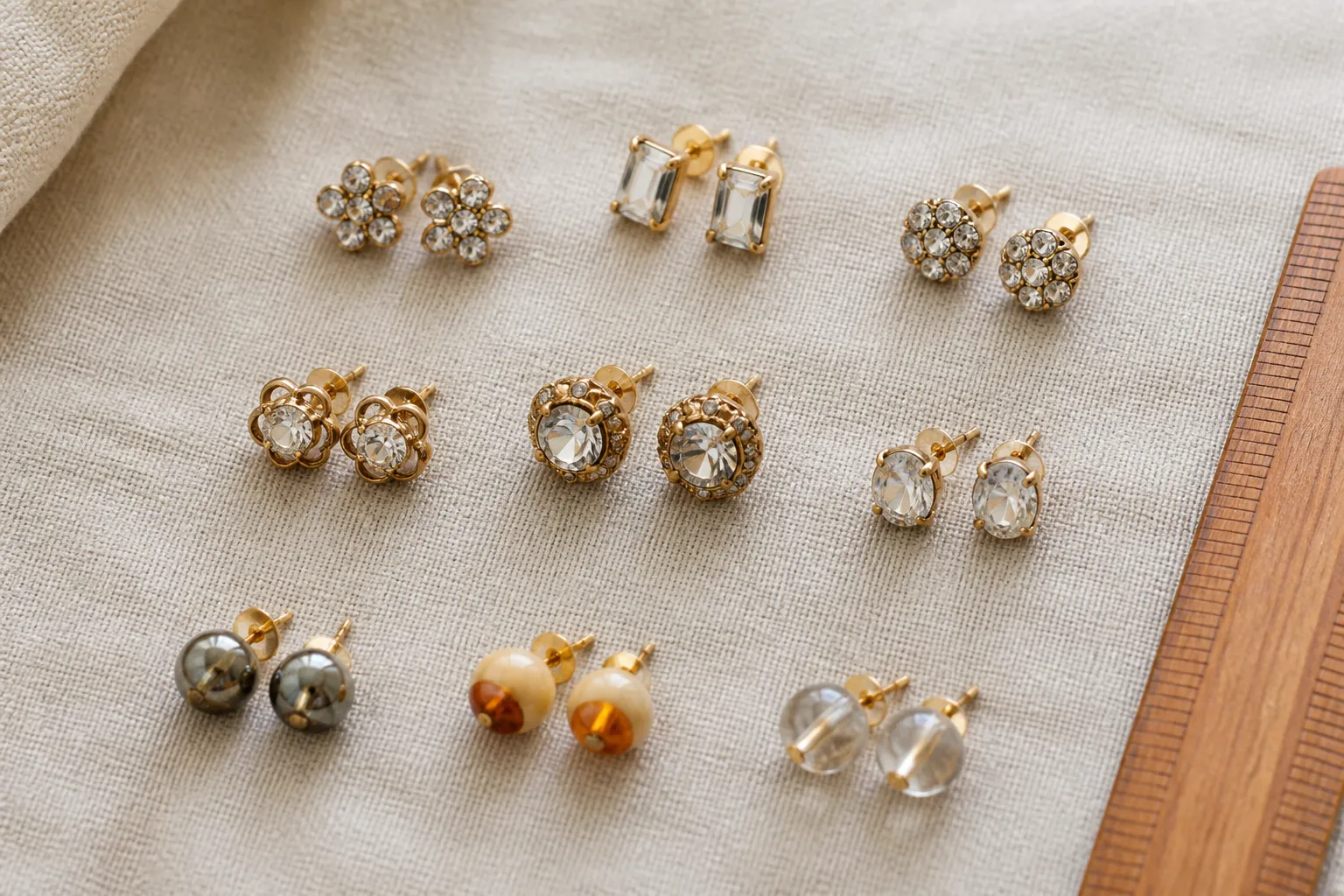
How gold stud earrings addresses it: Structuring the stud range around style families — vintage cluster, gradient crystal, two-tone glass bead, classic ball — from a single OEM partner means consistent base metal, consistent plating spec, and consistent post/clutch hardware across the entire range. Buyers can brief a supplier once on finish standards and have those standards replicated across 8–12 SKUs rather than negotiating each separately.
What success looks like: Reduced return rates attributed to quality inconsistency; faster product page launch cycles (fewer approvals required when samples consistently hit the brief); higher average order value as customers buy matching sets rather than individual pieces.
Example scenario: A US-based DTC brand building a Valentine's Day capsule briefs STRAND on a four-piece stud range — round rhinestone, heart-cut crystal, gold ball, and vintage floral cluster — all in the same warm gold tone. Because the brief goes to a single vetted workshop, all four samples arrive at the same plating spec, photograph with consistent color, and ship in the same packaging insert.
2. OEM Private Label Production: Putting Your Brand on Gold Studs at Low MOQ
The problem: Independent retailers, DTC brands, and multi-brand boutiques increasingly want their own branded packaging and, in some cases, custom earring designs — but traditional OEM minimums for jewelry often start at quantities that make sense for mass retail, not for small-batch DTC operators testing a new category.
How gold stud earrings addresses it: Low MOQ OEM production specifically for fashion-grade gold stud earrings makes private label viable at an earlier revenue stage. Buyers can order a test quantity with custom backing cards, jewelry pouches, or branded tags to validate the category with their customer base before scaling. Custom design work — adjusting stone color, post length, or base shape — can happen within a defined sampling process with clear revision milestones.
What success looks like: First branded earring collection launched without overcommitting inventory; custom designs sell at a price premium relative to unbranded wholesale; reorder cycles established on top-performing SKUs within the first two seasons.
Example scenario: A UK-based lifestyle brand with an existing scarf and bag range wants to extend into jewelry. STRAND produces 200 units of a custom gradient crystal gold stud earring with the brand's signature color palette, packed in branded organza pouches. The collection sells through in three weeks, triggering a 600-unit reorder with two new colorways.
3. MENA Market Procurement: Navigating Import Requirements for Gold-Tone Fashion Jewelry
The problem: The MENA region represents a high-value market for gold stud earrings, but procurement teams face a specific set of regulatory and presentation requirements that suppliers unfamiliar with the market routinely miss. Hallmarking conventions, nickel-release regulations (mirroring EU standards in some GCC markets), and packaging language requirements all affect whether a shipment clears customs cleanly or gets held.
How gold stud earrings addresses it: Working with a supplier that has established export experience in MENA channels — and can communicate in Arabic through the procurement process — reduces the friction of aligning on compliant product specifications before production begins. Buyers should confirm with suppliers whether pieces are produced to nickel-release standards (aligned with EU Directive 94/27/EC as a baseline), and whether certificate of conformity documentation is available for customs declaration.
What success looks like: Shipments clear GCC customs on first presentation; product labeling satisfies in-market requirements without re-work at the destination warehouse; procurement team can brief on spec changes in Arabic without accuracy loss in translation.
Example scenario: A Dubai-based multi-door accessories retailer needs 1,500 units of gold stud earrings with Arabic-language care cards for a Ramadan gifting promotion. STRAND's Arabic-language procurement support ensures the product brief, compliance documentation, and artwork review all happen in the buyer's first language, compressing the approval cycle by two weeks.
4. EU & UK Market Entry: Nickel Compliance and REACH Regulation for Fashion Jewelry
The problem: EU and UK fashion jewelry sold to consumers must comply with REACH regulation — specifically the nickel restriction under Annex XVII, which limits nickel release from earring post assemblies to 0.2 μg/cm²/week (0.5 μg/cm²/week for other items in prolonged skin contact). Buyers sourcing fashion-grade gold stud earrings from Chinese workshops without explicit compliance verification are carrying regulatory liability that can result in product recalls, marketplace suspensions, and reputational damage with retail partners.
How gold stud earrings addresses it: Procurement evaluation for EU/UK market entry must include explicit confirmation of surgical steel, titanium, or other nickel-compliant post materials, and ideally third-party test reports (e.g., SGS, Bureau Veritas, or equivalent) demonstrating compliance with EN 1811:2011+A1:2015. Buyers should request batch testing certificates rather than relying on supplier self-declaration alone. Suppliers with established EU/UK export workflows will have these documents as standard deliverables.
What success looks like: Product passes Amazon EU marketplace compliance checks without delisting; retail partners in Germany and France accept shipments without additional documentation requests; brand avoids recall events driven by nickel contact dermatitis complaints.
Example scenario: A German online accessories retailer sources a range of gold stud earrings from STRAND and receives SGS test reports confirming post compliance with EN 1811 nickel release standards. The reports are pre-formatted for upload to Amazon.de's compliance portal, eliminating a two-week back-and-forth that had delayed previous seasonal launches.
5. US Market Wholesale & DTC: Cadmium/Lead Compliance and Prop 65 Considerations
The problem: Fashion jewelry sold in the United States — particularly in California — faces scrutiny under Proposition 65 (Safe Drinking Water and Toxic Enforcement Act of 1986), which requires warnings for products containing chemicals including lead and cadmium above threshold levels. Fashion jewelry has been a historically high-risk category for Prop 65 enforcement actions, and buyers selling through major US marketplaces or physical retail increasingly face compliance verification requirements from their retail partners.
How gold stud earrings addresses it: US-bound gold stud earrings should be produced to lead-free and cadmium-free standards where possible, with third-party test reports confirming compliance. Buyers should ask suppliers whether pieces are tested to CPSC standards and whether Prop 65 warning labels are required based on material composition. Zinc alloy base metals with proper production controls can be manufactured to compliant specs; the key is having documentation rather than assuming.
What success looks like: Product lists on US retail marketplaces without compliance flags; no Prop 65 demand letters received in the first 12 months of retail distribution; retail partner compliance questionnaires completed without exception.
Example scenario: A US wholesale distributor supplying gift boutiques in California requests Prop 65 compliance documentation from STRAND before placing a reorder on rhinestone gold stud earrings. Receiving test reports within five business days allows the distributor to fulfill a boutique chain's compliance form requirement ahead of the holiday buying deadline.
6. Trend-Responsive Inventory: Rapid Style Development for Seasonal and Viral Demand
The problem: Fashion jewelry trend cycles have compressed dramatically. A stud earring style that goes viral on TikTok or Pinterest can move from trend signal to peak demand in four to six weeks — far faster than the production timelines of traditional wholesale buying. DTC brands that cannot source and receive new styles within a compressed window miss the revenue window entirely.
How gold stud earrings addresses it: Suppliers with in-house sample development capability and fast-turnaround sampling timelines allow DTC buyers to move from trend identification to sample approval in days rather than weeks. Low MOQ production on new styles reduces the risk of testing an emerging trend, while established supplier relationships mean buyers skip the qualification phase on each new order. The key evaluation criteria: what is the supplier's sample lead time, what is the minimum quantity for a new style run, and how many concurrent new style developments can the workshop support per quarter?
What success looks like: New stud earring styles available on the DTC website within the active trend window; sell-through rate on trend-response SKUs exceeds 80% at full price; markdown exposure on slow-moving inventory reduced because small test batches contain downside.
Example scenario: A US DTC brand identifies a surge in search volume for "vintage floral gold stud earrings" in early February. STRAND produces samples within [supplier's stated sample lead time], and the brand approves a test run of 300 units. The style launches during the trend peak and sells through at full price before the trend cools.
Considerations Specific to Cross-Border Fashion Jewelry (DTC & OEM)
Regulatory & Compliance Framework
Fashion jewelry crosses multiple regulatory regimes depending on destination market. The key frameworks buyers sourcing gold stud earrings must understand:
- EU REACH (Regulation EC 1907/2006): Governs chemical substances including nickel, lead, and cadmium in fashion accessories
- UK REACH (post-Brexit): Maintained as a parallel regulation; test reports from EU-approved bodies are generally accepted
- California Prop 65: Requires warning labels for products with lead, cadmium, or other listed chemicals above threshold levels
- GCC/UAE: Aligns partially with EU standards; specific import documentation requirements vary by product category and country of destination
- CE Marking: Not mandatory for non-electrical jewelry, but buyers should confirm classification status with their customs broker
Buyers should request material composition declarations (in addition to test reports) as part of standard supplier onboarding.
Integration with Industry-Standard Procurement Tools
Cross-border fashion jewelry buyers increasingly manage supplier relationships through platforms such as:
- Alibaba Trade Assurance / 1688 cross-border: For initial supplier discovery and transactional protection
- Faire (EU/US wholesale): For DTC brands distributing to independent retail partners
- ShipBob / ShipMonk: For third-party logistics integration in the US
- Shopify / WooCommerce: For DTC product catalog and order management
When evaluating OEM suppliers, confirm that invoicing, shipping documentation (commercial invoice, packing list, certificate of origin), and QC reports can be delivered in formats compatible with your logistics workflow.
Data Sensitivity
For DTC brands, sharing upcoming style briefs, campaign concepts, and trend research with an OEM supplier represents genuine IP exposure. Buyers working with established OEM partners should maintain NDAs as standard practice and avoid sharing unannounced campaign materials through unencrypted channels.
Scale & Seasonality
Gold stud earrings have three high-demand windows that drive production planning decisions: Q4 holiday gifting (October–November production), Valentine's Day (December–January production), and Wedding/graduation season (March–April production). Buyers who have not locked in production capacity — or at minimum notified their OEM partner of anticipated volume — before these windows routinely face extended lead times or allocation constraints. The practical recommendation: begin seasonal procurement conversations at least 90–120 days before the target sell date.
Implementation Roadmap for Cross-Border Fashion Jewelry Teams
Phase 1 — Pilot (Weeks 1–8)
- Identify 2–3 gold stud earring styles to test as proxy for quality and supplier compatibility (e.g., one classic gold ball stud, one rhinestone cluster, one crystal style)
- Request samples with explicit plating spec, post material, and material composition declaration
- Commission third-party test for nickel release / Prop 65 compliance on sample units before full production approval
- Evaluate supplier communication quality: response time, technical accuracy, language support
- Place a small pilot order (
12 pcs) to assess production fidelity vs. sample and packaging execution
Phase 2 — Pilot Orders & Range Expansion (Months 2–4)
- Expand to full seasonal range (4–8 SKUs) based on pilot learnings
- Establish reorder triggers based on inventory velocity data from DTC platform
- Negotiate framework pricing for repeat styles to improve margin predictability
- Integrate supplier documentation into customs and compliance workflow
- Begin development briefing for next-season styles while current season is in production
Phase 3 — Supply-Chain Optimization (Months 4–12)
- Formalize OEM relationship with master supplier agreement covering IP protection, QC standards, and lead time commitments
- Develop exclusive or semi-exclusive styles to differentiate DTC catalog from competitive sourcing
- Explore adjacent product categories (necklace + earring sets, drop earrings) with the same vetted supplier base
- Review compliance documentation annually as regulations evolve in key destination markets
ROI & Business Outcomes for Cross-Border Fashion Jewelry Teams
The metrics that matter in this vertical are different from those in general merchandise sourcing. When evaluating the impact of a structured OEM gold stud earring program:
Return Rate Reduction: Fashion jewelry DTC stores with verified supplier QC programs consistently report lower earring return rates compared to unverified wholesale sourcing. Target benchmark: return rate below 3% for studs (industry elevated benchmarks run 6–10% for unverified sourcing).
Gross Margin Improvement: OEM pricing — even at modest MOQ — typically outperforms comparable wholesale catalog pricing by 15–30% on like-for-like styles, because buyers are paying manufacturing cost plus a defined margin rather than a wholesale markup on top of that margin.
Compliance Cost Avoidance: A single marketplace delisting, customs hold, or Prop 65 demand letter can cost multiples of the savings generated by sourcing from an uncertified supplier. Compliance documentation obtained upfront is an insurance policy with a predictable, low cost.
Time-to-Market Compression: DTC brands with an established OEM relationship launch new stud earring styles faster because they skip supplier qualification on each order cycle. Estimated time savings vs. sourcing each style from a new supplier: 2–4 weeks per style.
Customer Lifetime Value: Consistent quality in a high-repeat-purchase category like gold stud earrings drives repeat buying behavior. A customer who has a positive experience with a stud earring purchase is meaningfully more likely to buy matching drop earrings or a necklace set in the next browsing session.
Conclusion: What Cross-Border Fashion Jewelry Decision-Makers Should Do Next
The gold stud earring is not a commodity product — it is a category that exposes every weakness in a sourcing operation while rewarding the buyers who have invested in structured supplier relationships. For DTC brand operators, the path forward is clear: move from catalog sourcing to OEM relationships that give you control over style, quality spec, and brand presentation. For importers and wholesale distributors, the investment in compliance documentation pays for itself in avoided risk and faster retail onboarding.
The sourcing questions that determine your outcome in this category are specific: Who is testing your plating thickness and nickel release before shipment? Who can communicate a QC rejection in your team's language? Who can develop a new style sample within your trend cycle, not outside it?
STRAND is a Hangzhou-based fashion jewelry brand and OEM sourcing partner built specifically for overseas buyers in the US, EU, UK, and MENA markets. We connect procurement teams directly to vetted Chinese workshops producing gold stud earrings, drop earrings, rhinestone styles, vintage crystal studs, two-tone glass bead designs, and necklace + earring sets — with in-house QC before every shipment, transparent trade terms, and multilingual support in English, Arabic, and Spanish.
Ready to evaluate a supplier relationship for your next gold stud earring program?
- Request a sample pack across stud styles to evaluate plating quality and post materials
- Get MOQ and pricing for your target volume and style mix
- Submit a custom OEM brief for exclusive design development
Request a Quote or Get MOQ & Pricing → strandjewelry.com
Talk to our procurement team in English, Arabic, or Spanish — whichever works for your team. Inquiry response within one business day.
Keywords: gold stud earrings, gold earrings, stud earrings, OEM fashion jewelry, cross-border jewelry sourcing, DTC jewelry supplier, wholesale gold earrings, custom earring manufacturer China